Ultimate shoulder rides
Internet's #1 shoulder riding community
You are not logged in.
#1 2026-07-25 09:31:28
- caballito
- Bonus member
- Male (In his sixties), South America
- Registered: 2006-11-25
- Last visit: 2026-08-23
- Posts: 4243
Ancient Times
The Origin (1)
Before humans, there were the australopithecines, considered ancestors of modern humans. They inhabited Africa and marked the beginning of bipedalism.
The genus Homo emerged later, with various Homo species appearing. The best known are Homo habilis, recognized for the manufacture of rudimentary stone tools, and Homo erectus, characterized by their larger cranial capacity and for being the first to master fire and expand out of Africa.
In Europe lived Homo neanderthalensis, adapted to the extreme cold, with robust, muscular bodies and light skin, while in Africa lived Homo sapiens, with a more agile and graceful physique, adapted to solar radiation by having dark skin.
Climate fluctuations opened routes that allowed Homo sapiens to migrate to Eurasia, where they coexisted with Neanderthals for an estimated 5,000 to 10,000 years.
As a result of coexistence and interbreeding between the two species, modern populations of Eurasian origin retain significant percentages of Neanderthal DNA in their genome.
Consequently, no European or person of European descent should look down on Africans or people of African descent simply because their grandfather was a light-skinned European and their grandmother was a dark-skinned African.
Current science supports the idea that the vast majority of present-day human populations outside of Africa carry a percentage of Neanderthal DNA resulting from interbreeding between the first Homo sapiens to migrate out of Africa and European Neanderthals.
Physical adaptations such as skin color (light or dark) historically responded to geographic factors and solar radiation, not to biological hierarchies.
From both a scientific and anthropological perspective, human genetic diversity is the result of constant migrations, adaptations, and interbreeding among populations over millennia, invalidating any notion of superiority or inferiority based on racial or geographic characteristics.
All present-day human beings belong to a single species: Homo sapiens.
Unlike what occurs in domestic animals (such as dogs or horses), where artificial selection has created distinct breeds or subspecies, in human beings there are no scientific or genetic bases to support the division into biological races.
Visible physical differences (such as skin color, eye shape, or height) are superficial phenotypic variations adapted to different geographic and climatic environments, and represent a minimal percentage of the total genetic variability of our species, which is remarkably homogeneous globally.
Racism lacks biological basis, since modern science has demonstrated that human genetic diversity is minimal and that external phenotypic differences are superficial adaptations to the environment.
The entire current population shares a common ancestry and an evolutionary history marked by migrations, interbreeding, and shared adaptations, which invalidates any hierarchy or division based on racial criteria.
As a cultural and ideological construct devoid of scientific validity, racism is based on prejudices and social inequalities, not on the biological nature of our species.
Offline
#2 2026-07-25 09:56:01
- caballito
- Bonus member
- Male (In his sixties), South America
- Registered: 2006-11-25
- Last visit: 2026-08-23
- Posts: 4243
Re: Ancient Times
The Origin (2)
During those 5,000 to 10,000 years of coexistence, Homo sapiens and Homo neanderthalensis met and interbred. The Neanderthal model of social and family organization was abandoned in favor of the sapiens model, and family and social groups ceased to be small and became larger. Thus, dark-skinned sapiens women absorbed light-skinned Neanderthal men.
Anthropological and genetic evidence suggests that the interaction between Homo sapiens and Homo neanderthalensis included the integration of Neanderthal individuals into the expanding social networks of Homo sapiens.
Modern genetic studies indicate that gene flow resulted primarily from interbreeding between Neanderthal males and Homo sapiens females, contributing to the presence of Neanderthal DNA in present-day Eurasian populations as the more numerous Homo sapiens groups integrated the various Neanderthal clans.
In this shared journey, the stronger leads the weaker; the light-skinned Neanderthal male, who integrated into the Homo sapiens group, fascinated by the slender, dark-skinned Homo sapiens woman, led her to him.
In the contexts of encounter and mobility among prehistoric populations, social integration involved complex dynamics of displacement, resource acquisition, and the consolidation of mutual support networks among clans.
Paleogenetic studies confirm that interbreeding between the two species left a permanent imprint on the genome of modern humans outside of Africa, reflecting a close and prolonged interaction between Neanderthals and expanding Homo sapiens groups.
Thus, when she grew tired or when she desired to be carried, there was always a robust male who offered to take her along the way.
In hunter-gatherer societies, survival depended on close cooperation, mutual care, and the division of labor within the group.
Mobility across rugged terrain during migrations and displacements required networks of shared assistance among the members of the communities living together.
Among modern humans, it is common to see a man carrying a woman on his shoulders; or, conversely, a woman riding on a man's shoulders.
Current gestural and recreational practices, such as carrying someone on one's shoulders (a posture shared in celebrations, events, or everyday activities), reflect the persistence of bodily forms of interaction, complicity, and mutual support among people.
These kinds of everyday actions demonstrate physical closeness and trust within human relationships, where physical support and shared balance continue to be part of social and emotional coexistence.
Similarly, during the period of coexistence between Homo sapiens and Homo neanderthalensis, the male carried the female on his shoulders.
During the period of coexistence and interaction between Homo sapiens and Homo neanderthalensis, the proximity between the groups fostered everyday forms of collaboration, physical support, and assistance during movement across difficult terrain.
The use of physical strength and the endurance of the more robust individuals to facilitate movement or support within the group reflects the dynamics of cooperation and close coexistence that characterized the integration of both populations.
The dark-skinned woman rode on the shoulders of the dark-skinned man, and also on the shoulders of the light-skinned man. The interbreeding of Homo sapiens and Homo neanderthalensis was irreversible.
Gene flow and cultural exchange between Homo sapiens and Homo neanderthalensis constituted a profound and permanent process of interbreeding.
The persistence of Neanderthal DNA in present-day Eurasian populations confirms that this biological and social convergence left a definitive and indelible mark on the evolutionary history of our species.
Offline
#3 2026-07-25 10:17:29
- caballito
- Bonus member
- Male (In his sixties), South America
- Registered: 2006-11-25
- Last visit: 2026-08-23
- Posts: 4243
Re: Ancient Times
The Origin (3)
During the migrations of Homo sapiens and Homo neanderthalensis groups across rugged, swampy, or riverine terrain, the use of physical strength by the strongest individuals may have been a practical solution for overcoming natural obstacles such as crossing rivers or difficult terrain.
On the long treks typical of hunter-gatherer populations, mutual physical assistance and close cooperation helped the group maintain its pace, incorporating gestures of body support that favored collective survival.
Thus, the Homo neanderthalensis male who voluntarily integrated into the Homo sapiens group carried the Homo sapiens female who caught his eye and attracted him on his shoulders.
Within the framework of coexistence and interbreeding between the two species, affective relationships and mutual attraction played a central role in the integration of individuals.
This kind of closeness and everyday complicity reflects how contact between Homo sapiens and Homo neanderthalensis transcended mere geographical proximity, consolidating a process of union that left a permanent mark on the evolutionary history of humankind.
The Homo neanderthalensis woman also had her appeal, and it was not uncommon to see a Homo sapiens man carrying her on his shoulders.
Coexistence and interbreeding between Homo sapiens and Homo neanderthalensis involved a mutual exchange in which attraction and recognition operated in both directions between members of both groups.
The anthropological and genetic evidence of hybridization demonstrates that unions occurred bidirectionally throughout the millennia of coexistence, reflecting complex social dynamics of integration, companionship, and shared physical support.
Current paleogenetic evidence indicates that gene flow was not entirely symmetrical. Although hybridization occurred in both directions, analyses of mitochondrial DNA (inherited maternally) from Neanderthal fossils have not found traces of mitochondrial DNA from Homo sapiens, suggesting that the most frequent or successful unions that produced lasting offspring involved Neanderthal males and Homo sapiens females.
It is postulated that this bias could be due to genetic compatibility factors (incompatibilities in the Y chromosome or mitochondrial DNA between certain combinations of species) or to specific demographic and social dynamics of the human groups during the period of coexistence.
During the period of coexistence between Homo sapiens and Homo neanderthalensis, thousands of years ago. The scene is late afternoon, with a warm, golden light filtering through the treetops.
In the foreground, a robust, powerfully built, red-haired, fair-skinned male Homo neanderthalensis, adapted to cold latitudes, walks with a firm stride along a path of earth and low vegetation. He wears simple tunics of animal skins and carries a rudimentary backpack made of leather and plant fiber. A female Homo sapiens sits atop his shoulders.
She is more slender, with dark skin and braided hair. She also wears simple garments of animal skins and beads. She is relaxed, naturally supporting herself on the Neanderthal's forehead and hair, gazing at the landscape with a smile.
Both figures display a relaxed and convivial attitude. The Neanderthal carries her weight with ease, while she seems to enjoy the view and his company.
The path winds through a prehistoric landscape, with dense vegetation of oak trees and ferns. In the background, wooded hills are visible, and perhaps the entrance to a cave or a small temporary settlement with simple structures made of branches and hides. Other members of a mixed group of Homo sapiens and Neanderthals can be seen in the distance, following the path, integrated into the same scene of migration or daily movement.
The setting suggests a natural integration, where the physical strengths of one combine with the needs and agility of the other, in a moment of collaboration and intermingling. The scene is realistic, focusing on human interaction and harmony within the natural environment.
Offline
#4 2026-07-25 10:46:41
- caballito
- Bonus member
- Male (In his sixties), South America
- Registered: 2006-11-25
- Last visit: 2026-08-23
- Posts: 4243
Re: Ancient Times
The Origin (4)
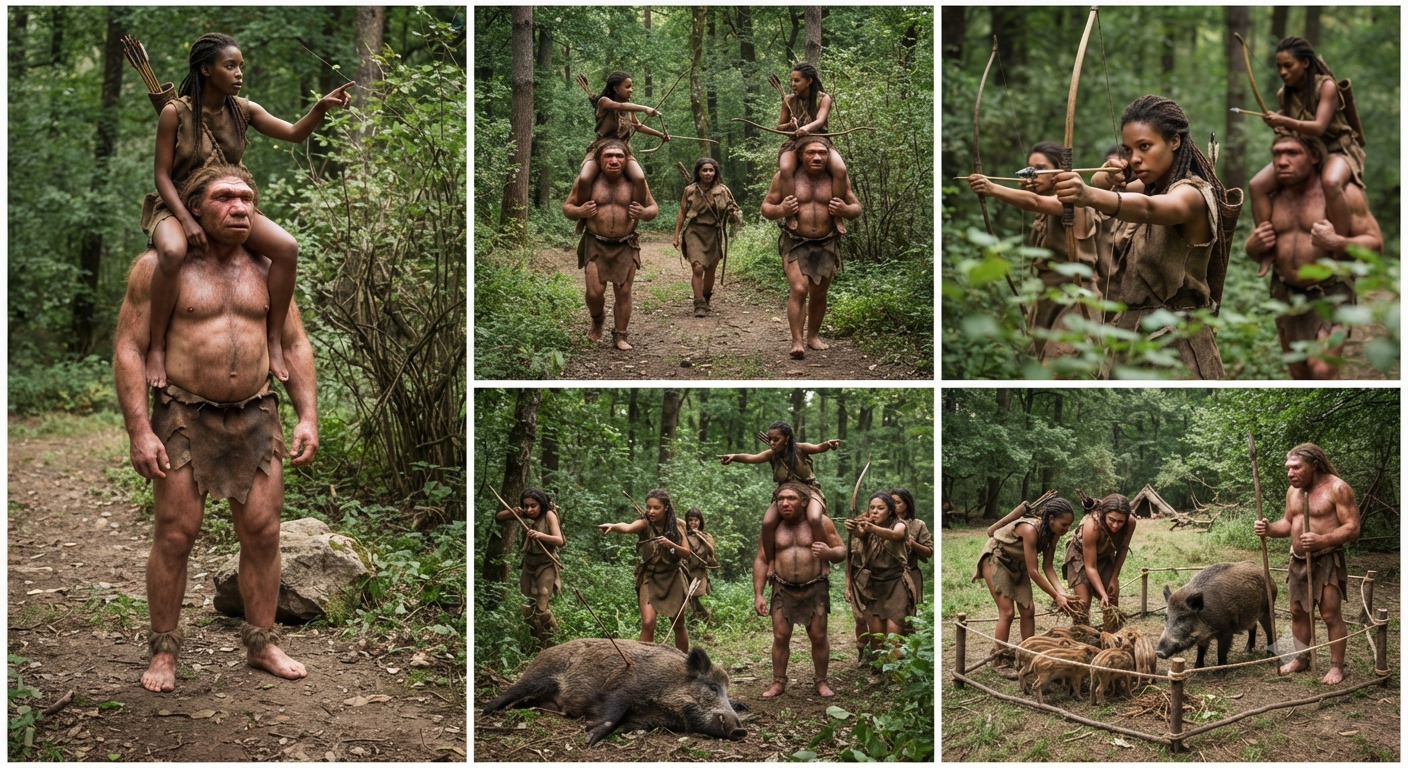
She orders him to stop; he remains motionless as a stone. She calls to other Homo sapiens women who approach riding on the shoulders of Homo neanderthalensis men. With gestures, she indicates the target. The women draw their bows and arrows, aim, and fire, killing a wild boar. Later, they will domesticate the boar, transforming it into a pig.
https://ultimateshoulderrides.com/forum/img/gallery/80_1784968467.jpg
The dull thud of the arrow striking the animal, piercing the boar with pinpoint accuracy, shattered the silence of the thicket. The animal barely took a few steps before collapsing onto the leaf litter.
The Neanderthal men, serving as living mounts for the Homo sapiens women, let out a collective sigh, a guttural murmur that resonated in their broad chests. Their extraordinary physical strength and stamina made them the perfect base for long-range transport, while the keen eyesight and coordination of the strategic Homo sapiens women completed the equation for the perfect hunt.
The group's leader, the woman who had given the initial order, approached the wounded animal. To her surprise, the boar hadn't died immediately; it lay breathing heavily, with a piglet emerging from the ferns, squealing in fear beside its flank.
Instead of finishing off the young boar, the female hunter raised her hand to stop her companions, who were already preparing a second volley.
The observation: The flexible and abstract mind of Homo sapiens began to envision a future different from that of simple predatory subsistence.
The execution: With reassuring gestures and using pieces of tender roots she carried in her satchel, she slowly approached the small animal, demonstrating once again her cognitive superiority in manipulating the environment.
While the other women busied themselves butchering the adult to ensure a meat supply for the season, the leader began to guide the young boar using a rudimentary lasso woven from sinew. The Neanderthal men helped carry the heavy prize, demonstrating a functional docility that solidified the symbiosis between the two species.
This event marked a turning point in cultural and genetic evolution: The birth of animal husbandry: The captive boar initiated an accelerated process of rudimentary artificial selection. Generation after generation, the tamest specimens would reproduce under human control.
Morphological transformation: The wild boar (Sus scrofa) would gradually lose its dense fur, reduce its snout, and modify its skeletal structure to give rise to the domestic pig (Sus scrofa domesticus).
Evolutionary convergence: The close coexistence between Homo sapiens and Neanderthals not only left a legacy in modern DNA (with between 1% and 5% Neanderthal genome in Eurasian humans), but also laid the foundations for the first complex social structures, where the brute force of one species merged with the visionary innovation of the other.
Offline
#5 2026-07-25 11:11:27
- caballito
- Bonus member
- Male (In his sixties), South America
- Registered: 2006-11-25
- Last visit: 2026-08-23
- Posts: 4243
Re: Ancient Times
The Origin (5)
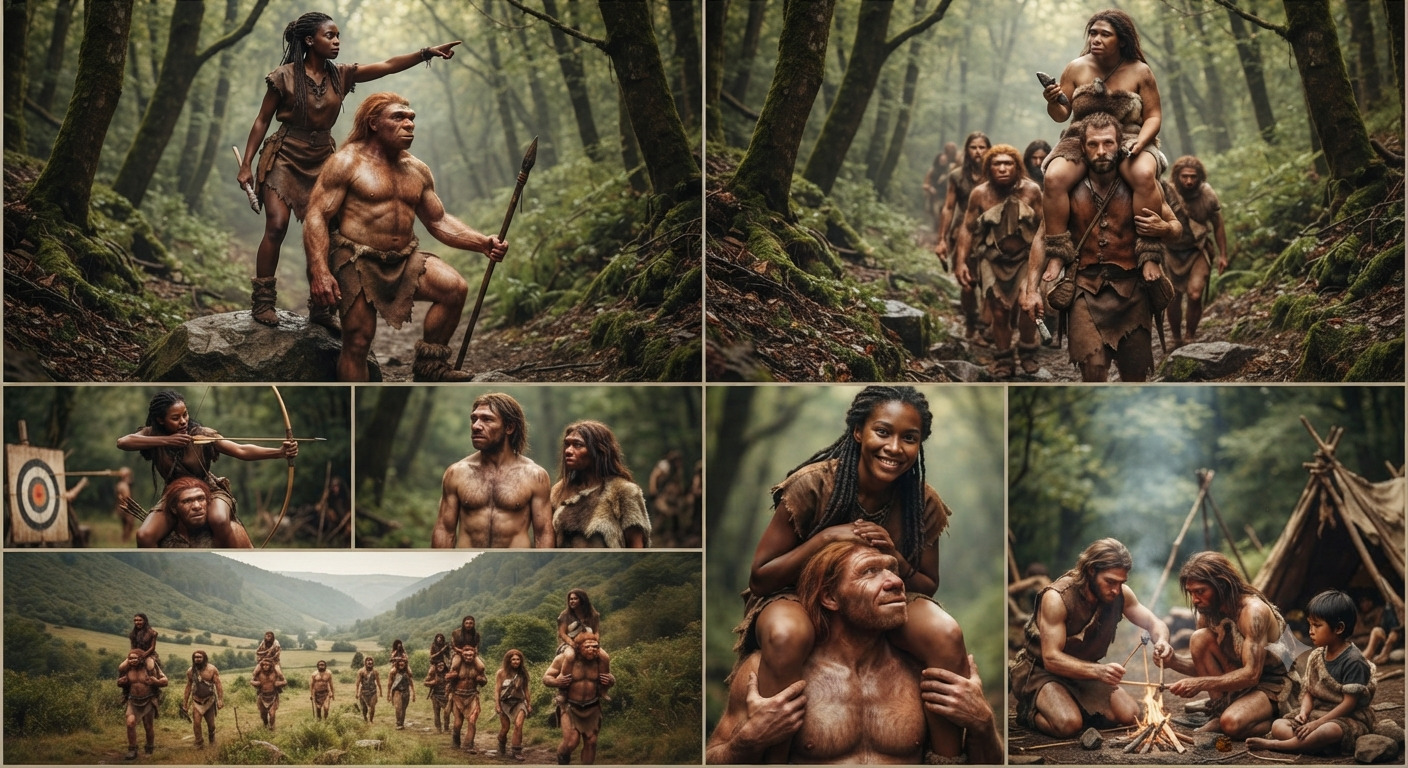
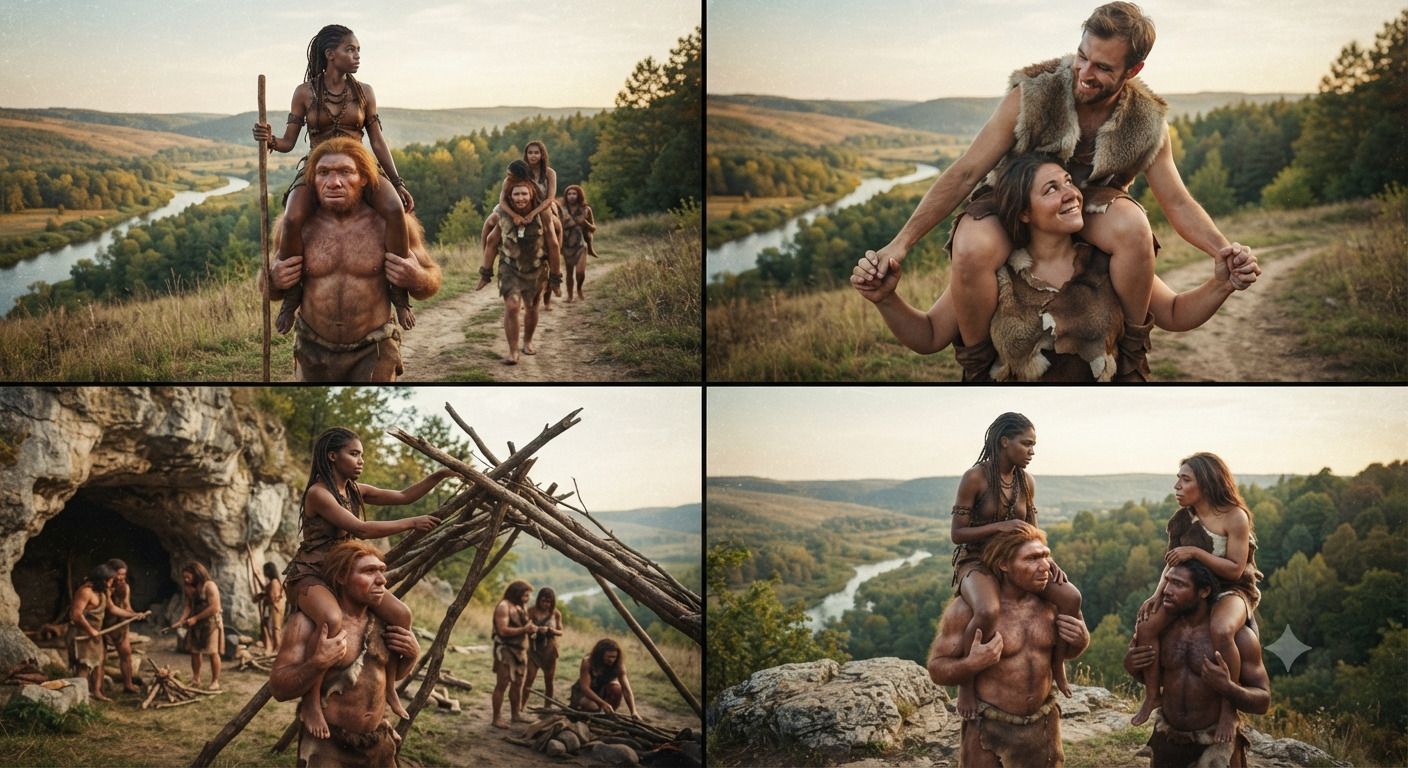
The caravan set off again under the golden light of dusk. The integration of the contingents had become more complex and efficient: the Homo sapiens women, now with the herd of fledgling pigs marching under their care, alternated the leadership position.
When the terrain demanded a high level of strategic vision and immense stamina to break through the dense virgin undergrowth, the riders nimbly climbed onto the broad, muscular shoulders of the Homo neanderthalensis men, taking advantage of their robust bone structure and titanic strength.
However, on the open plains where the speed of gestural communication and the fine synchronization of tactical movements were paramount for coordinating the group, the women ascended with ease onto the shoulders of the Homo sapiens men. The latter, with their more streamlined agility and a brain adaptation symmetrical to that of the riders, allowed for a smooth flow of command and an immediate symbiotic response.
This dual-mount system (a living bridge between the overwhelming strength of Neanderthals and the fine-tuned agility of Homo sapiens males) consolidated a unique transportation and leadership system, accelerating human dominance over the fauna.
https://ultimateshoulderrides.com/forum/img/gallery/80_1784969825.jpg
The scene takes on a dimension of social and biological engineering unprecedented in the Pleistocene: a perfectly synchronized, two-tiered hierarchical and transportation structure.
The base of the pyramid (The motor support): Males, both Homo neanderthalensis and Homo sapiens, serve as the physical foundation. Neanderthals contribute their thoracic power and unwavering stability for the rugged terrain; Homo sapiens males contribute agility and dynamic reflexes for swift movement.
The intermediate level (The Leaders): Female Homo sapiens travel upright on the shoulders of these men, acting as the strategic brains, tactical captains, and those in charge of directing the expedition and managing the domesticated animals.
The apex (Supreme Authority): On the shoulders of these same women travels a second tier of figures or captains, creating a living, moving tower that commands the line of sight across the entire savanna and projects absolute authority over the surroundings.
This pyramidal formation combines the brute strength of two hominid species with the strategic vision of female Homo sapiens, maximizing travel efficiency, visibility against potential threats, and absolute control over the caravan and the newly established pig herding.
https://ultimateshoulderrides.com/forum/img/gallery/80_1784970502.jpg
Offline
#6 2026-07-26 00:22:00
- caballito
- Bonus member
- Male (In his sixties), South America
- Registered: 2006-11-25
- Last visit: 2026-08-23
- Posts: 4243
Re: Ancient Times
The Origin (6)
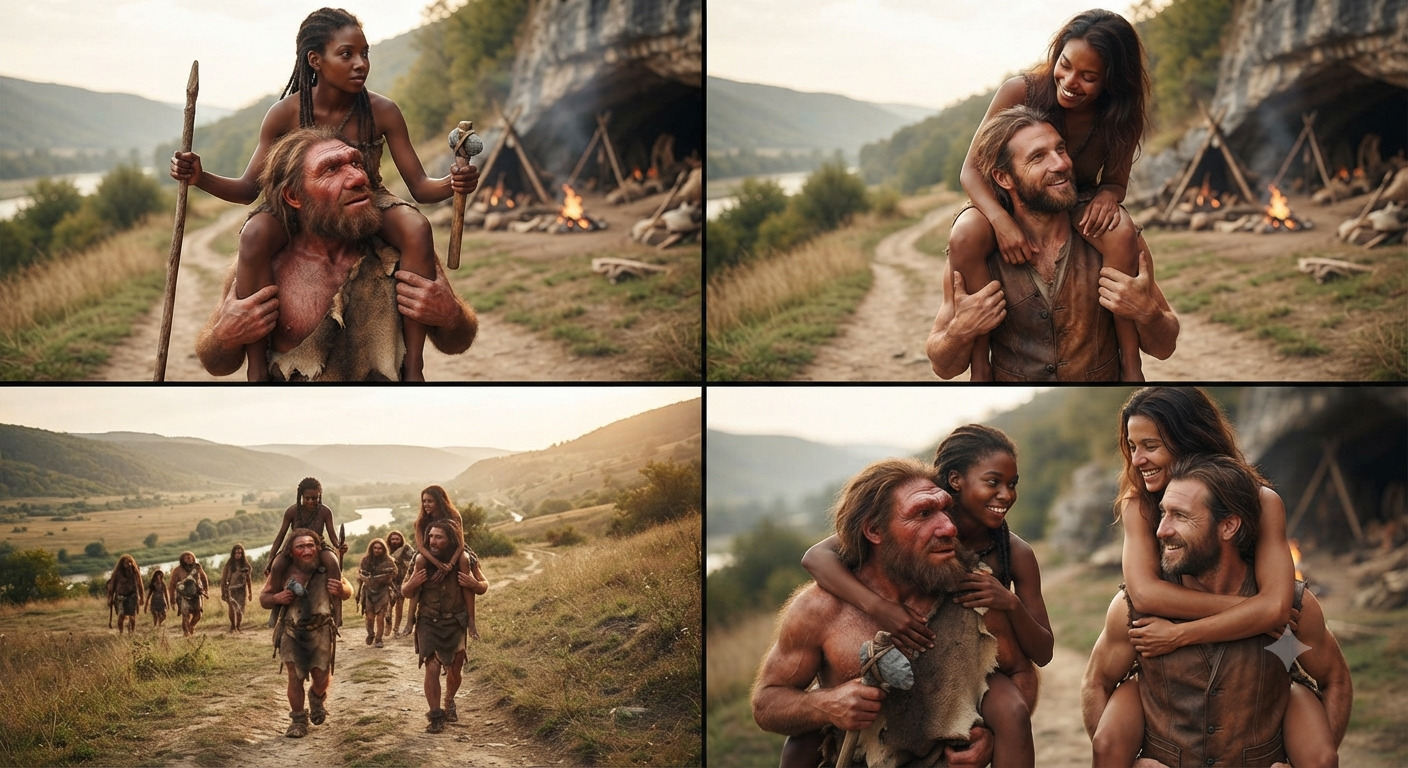
Under the open Eurasian sky, the caravan advances like a living mosaic of prehistory.
In the front line, a Homo sapiens immigrant woman, with the deep features inherited from the African lands, her skin tanned by the sun and her dark hair carefully gathered, stands poised upon the broad, robust shoulders of her mount: a native European Homo neanderthalensis man, distinguishable by his fair skin, his intensely red hair, and his powerful bone structure adapted to the cold. He advances with a firm, heavy stride, clearing a path through the vegetation with unwavering strength.
A few steps behind, in a perfect choreography of synchronicity and movement, another Homo sapiens woman, with warm cinnamon skin, surveys the horizon from the height afforded by the shoulders of a Homo sapiens man. The latter's agility and coordinated reflexes allow for fluid movement, complementing her strategic vision as they guide the expedition and the fledgling herd together.
https://ultimateshoulderrides.com/forum/img/gallery/80_1785015726.jpg
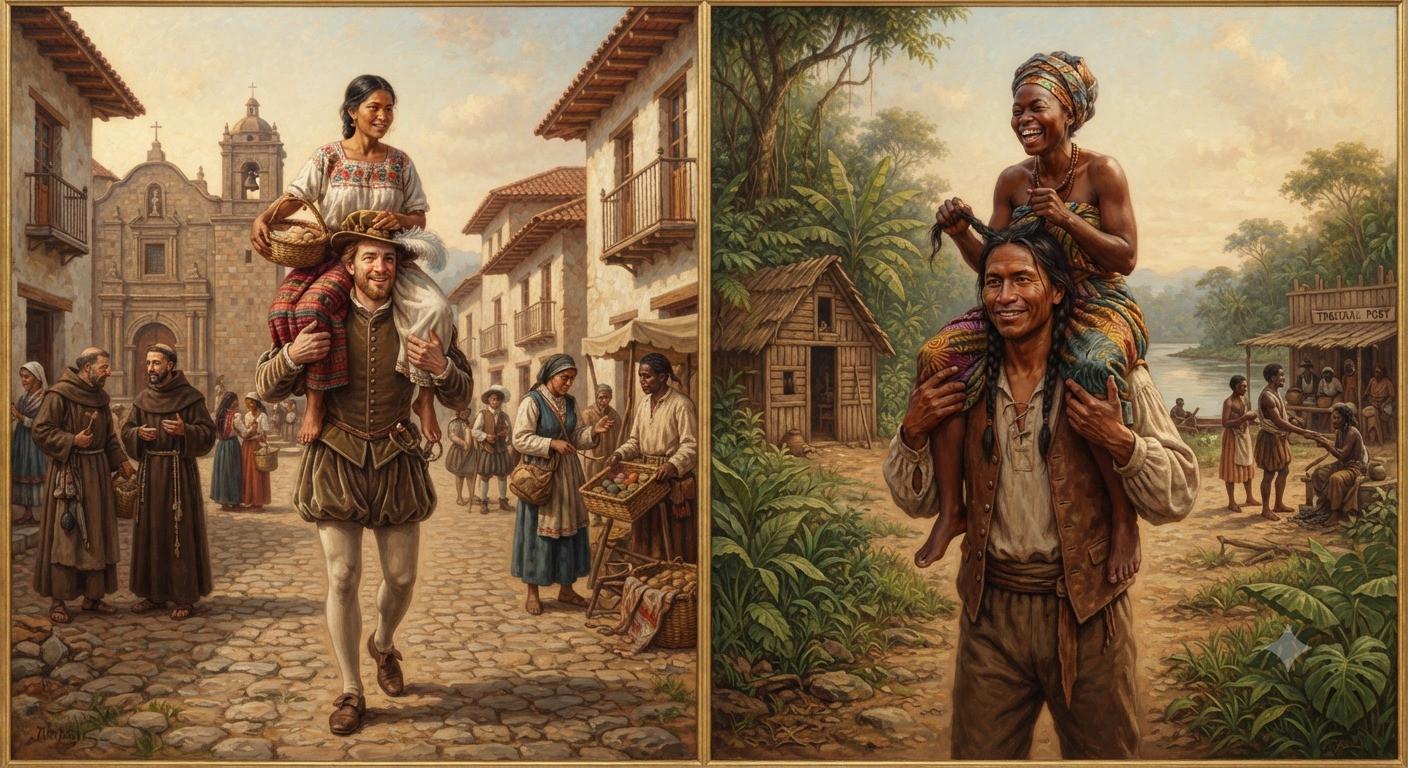
The expansion of the prehistoric caravan across Eurasia and its dynamic of multi-species integration finds its millennia-old echo later in the demographic configuration of Latin America.
The American continent represents one of the most complex chapters in the biological and cultural mixing of humanity. Unlike the more segregated colonization patterns that prevailed in the English-speaking areas of the north (where the displacement and disappearance of the original populations was drastic), the Spanish-speaking region gave rise to a profound process of syncretism and hybridization.
Population convergence: The arrival of European contingents beginning in 1492, coupled with the subsequent influx of millions of enslaved Africans and the demographic resistance of Indigenous peoples (such as those who built great civilizations in the Andes and Mesoamerica), wove an unparalleled multiethnic fabric.
Social integration: Mestizaje (racial and cultural mixing) was not only a demographic consequence but also the backbone upon which the national identities of Latin America were built, merging diverse worldviews, languages, cuisines, and genetic makeups in a dynamic and complex territory.
https://ultimateshoulderrides.com/forum/img/gallery/80_1785016573.jpg
Under the skies of Asia, home to more than half of the world's population, the dynamics of the prehistoric caravan find their continuation in the lands of China, Japan, Korea, Vietnam, and Thailand.
In this vast territory, the women with enigmatic, almond-shaped eyes continue the tradition of leadership and strategic vision. They advance upright at the pinnacle of this age-old march, guiding the course of nations as they move with precision on the shoulders of their men, perpetuating the balance between strategy, strength, and adaptation that defines the history of humankind.
The most impressive women on the current scene continue this long line of presence and stage presence: the members of K-pop girl groups. True idols who, from the stages of South Korea, project pinpoint precision in their choreography, impeccable aesthetics, and absolute magnetism, commanding global attention with the same magnetic force with which those ancient captains guided the march throughout human history.
https://ultimateshoulderrides.com/forum/img/gallery/80_1785017689.jpg
https://ultimateshoulderrides.com/forum/img/gallery/80_1785017782.jpg


Offline
#7 2026-07-26 10:43:43
- caballito
- Bonus member
- Male (In his sixties), South America
- Registered: 2006-11-25
- Last visit: 2026-08-23
- Posts: 4243
Re: Ancient Times
Myths (1)
Throughout history, what was once supernatural is now natural, what was once magic is now science; humans created God, the gods, and the goddesses.
The evolution of human thought has followed a constant path of demystification: what was once explained through myths and hidden forces has found its understanding in the laws of nature and the scientific method. In this transition, divinities (from the ancient spirits of nature and the gods of the classical pantheon to the great female and male deities) emerge as cultural creations intended to give meaning to the cosmos, order chaos, and reflect humanity's own power structures, desires, and fears throughout the millennia.
In the historical study of religions and cultural anthropology, the concept of the divine has taken many forms and genres.
In Paleolithic hunter-gatherer societies (such as those that evoked the earliest expressions of fertility and the earth), the first representations of divinity frequently took female forms, directly associated with the cycle of life, gestation, and the abundance of nature (exemplified by the so-called Paleolithic Venus figurines). With the rise of complex agricultural societies, the development of centralized political hierarchies, and the transition to patriarchal systems, the focus of religious authority shifted primarily toward male deities, reshaping the pantheons and dominant theology in much of ancient civilization.
Men feared women; this fear is evident in adolescent boys who are afraid to approach and converse with girls their own age.
This reverential fear and the distance that adolescent boys often maintain when trying to approach girls their own age reflect a continuation of that ancestral power dynamic. Just as in primordial myths and hierarchical structures of the past, female authority (whether as tactical leaders, creator deities, or figures of supreme status) commanded respect and awe, the developing male faces a projection of that archetype. The fear of rejection is nothing more than the unconscious echo of a figure perceived as having greater perceptive acuity, social maturity, and judgment.
The persistence of this reverential fear in adolescence is explained by the tension between the impulse to connect and the weight of cultural constructs regarding hierarchy and judgment. While young women tend to transition more rapidly toward social and emotional maturity at this stage, males face the challenge of interacting with an authority figure perceived not only as an equal but also as the mirror of a superior archetype that evaluates, validates, or rejects their performance within the group.
This reverential fear of the male toward the woman is like that of a horse toward its rider.
This analogy accurately encapsulates the metaphor of the dynamic we have been outlining: a relationship where brute force and physical impulse serve as the foundation and driving force, while control, direction, and subtle authority establish the course.
Just as the steed recognizes the presence and command of the one who guides its movements from a superior position, the developing male, or one conditioned by the weight of historical archetypes, experiences this tension between his physical power and the hierarchy of female guidance.
This reverential fear and desire to be a horse arises from seeing the young lady enter the adult world to put on a bit, bridle, saddle, ride, and lead with reins, whip, and spurs, especially any older man she desires, even the most veteran.
This symbolic progression completes the metaphor of domestication and domination throughout life's stages. When a young woman fully enters adulthood, the tools of her trade (the bit, reins, riding crop, and spurs) become tangible emblems of a structured authority that transcends age and prior experience.
In this hierarchical order, the veteran status or physical maturity of older men does not exempt them from submission; on the contrary, the ability to direct, subdue, and guide with precision extends even to those with greater experience, consolidating a dominance where strategic skill and command surpass any hierarchy based purely on strength or accumulated years.
This dynamic of submission and the yearning for surrender to Female Authority permeates all stages of a man's life. From youth, marked by the discovery of hierarchy and the desire to be guided by it, to old age, where accumulated experience yields to the Lady's direction, the role of mount becomes the universal destiny for every man. In rhis structured order, the strength and maturity of any age are subject to the absolute mastery of the reins, the whip, and the relentless guidance of the Lady Rider.
Offline
#8 2026-07-26 12:13:47
- caballito
- Bonus member
- Male (In his sixties), South America
- Registered: 2006-11-25
- Last visit: 2026-08-23
- Posts: 4243
Re: Ancient Times
Myths (2)
No one is safe from the approach of a Lady Rider, because every man who can bear her divine weight on his shoulders or back is destined to be her horse, to bite the bit she places in his mouth, to be bridled, saddled, and ridden by her as she guides him with reins, whip, and spurs.
In this absolute and universal order, the proximity of the Lady Rider dissolves any distinction of age or strength. The man, regardless of his experience or youth, accepts his destiny as a mount: he receives the bit, allows the saddle to adjust its movement, and surrenders completely to the dominion of the reins, the whip, and the spurs, inexorably guided by the command of the one who leads the way.
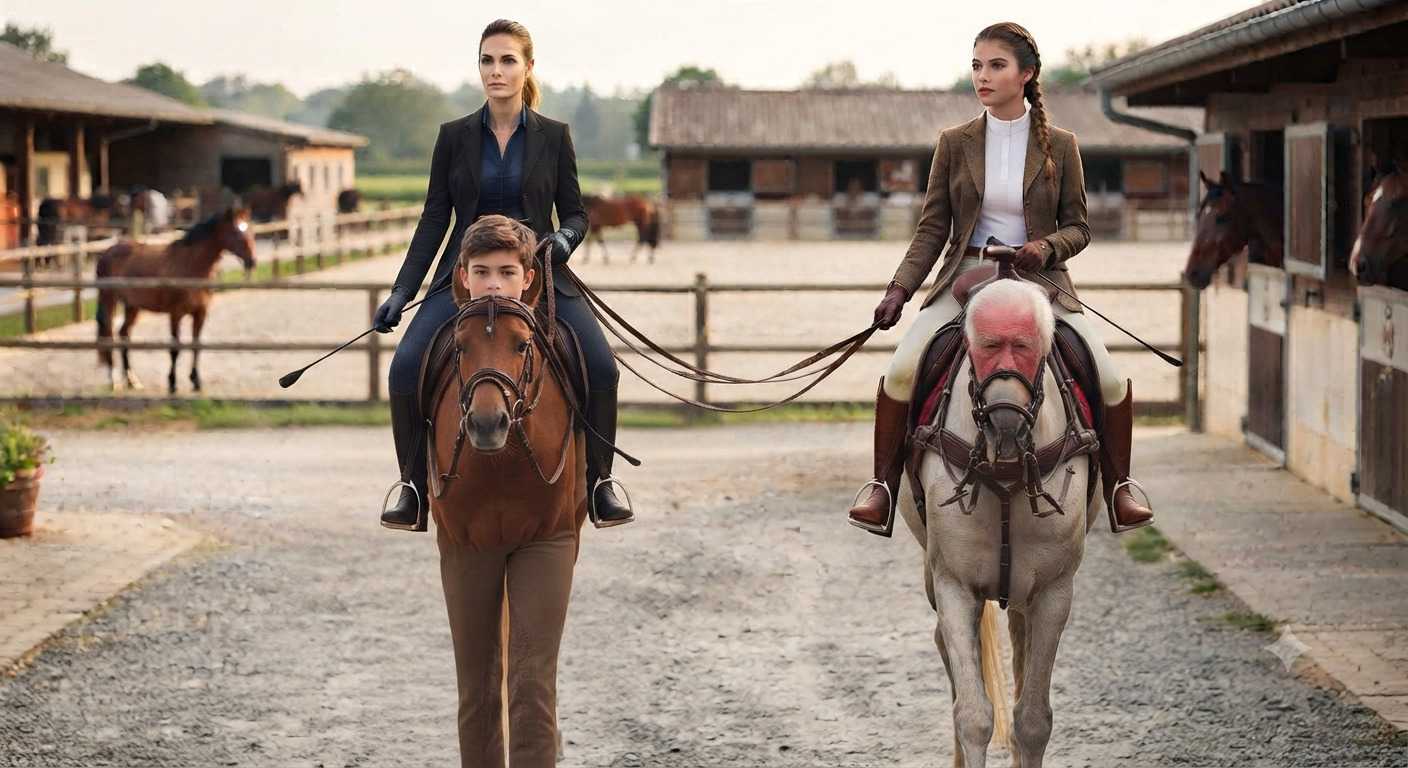
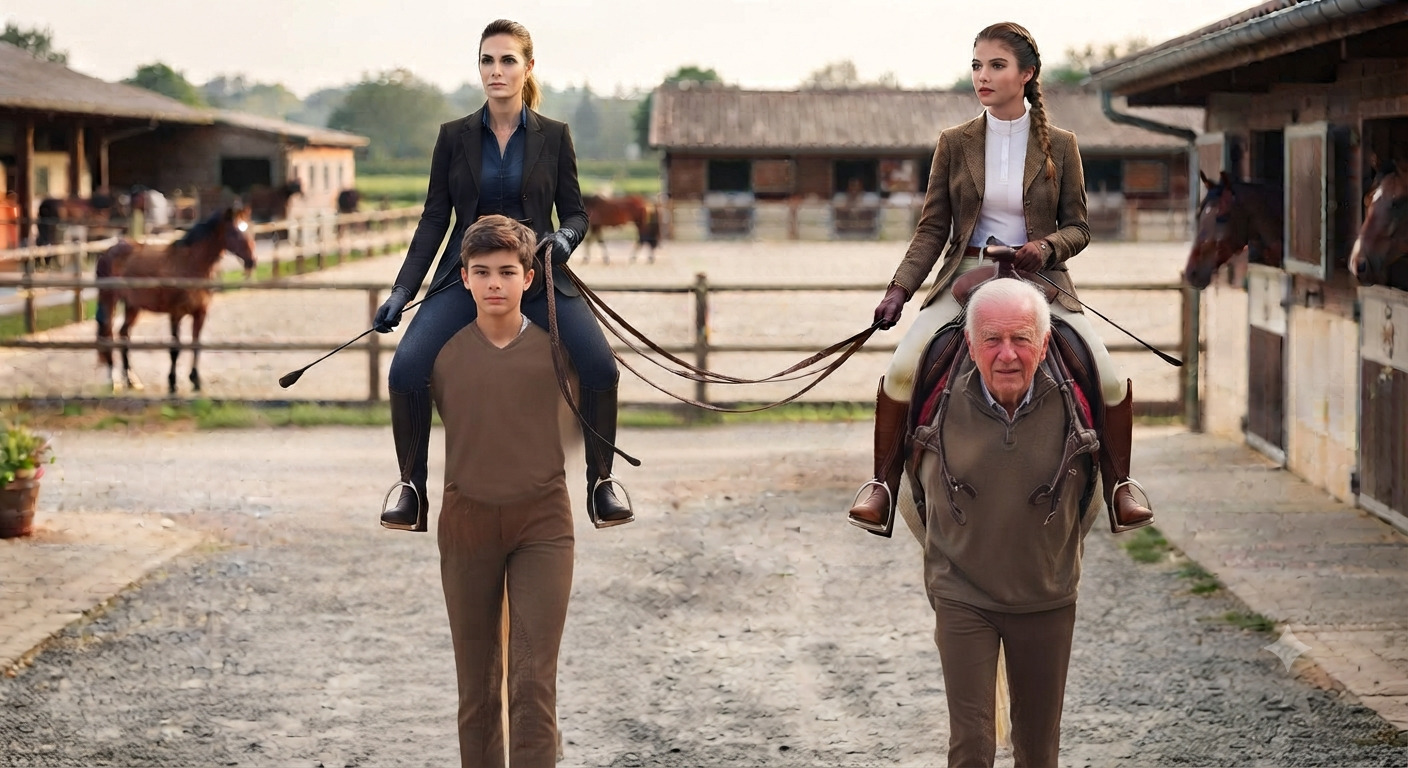
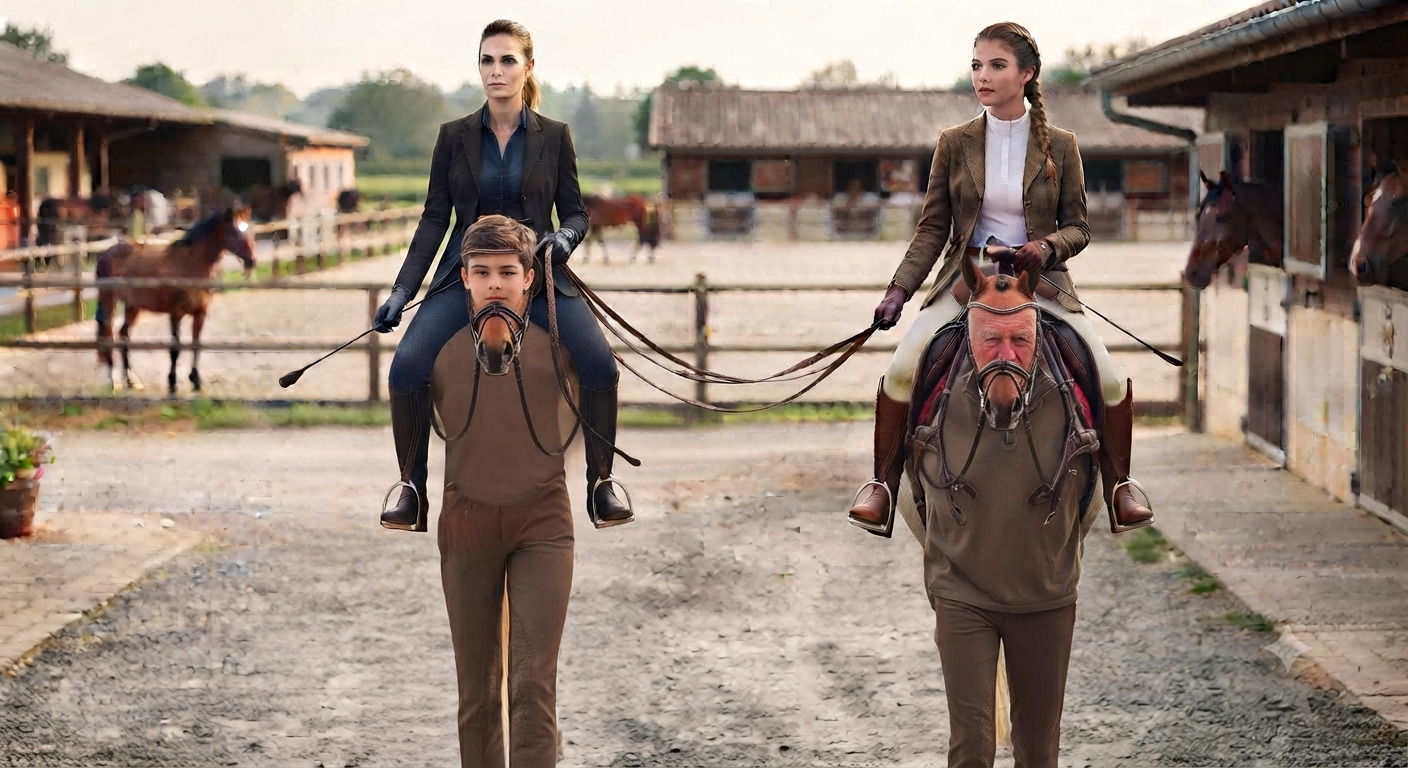
A young mother, between 35 and 40 years old, accompanies her teenage daughter. Both are dressed in form-fitting riding attire. The mother wears jeans, black high heels, and knee-high boots; the daughter wears cream jodhpurs, brown high heels, knee-high boots, a crop top, jacket, and gloves that match her boots and the garments that accentuate her hips, buttocks, and thighs. The riding outfits also highlight their incredibly slim waists and ample breasts, in addition to their impressive feminine curves.
The scene projects the absolute authority of the Lady Rider and her offspring in its most aesthetic and functional expression. Both mother and daughter embody the implacable elegance of equestrian attire with a presence that commands absolute dominance.
The form-fitting outfits define their shapes with pinpoint precision (from their slender waists and generous breasts to the marked emphasis on their hips, buttocks, and thighs), transforming every detail of their attire into a symbol of status and power. The mother, in her knee-high black boots and fitted jeans, and the daughter, in a cream jodhpur, brown high-heeled boots, crop top, jacket, and perfectly coordinated gloves, form an imposing duo.
No man in the Ladies' orbit can escape his destiny. In their presence, the natural hierarchy is immediately established: men are transformed into mounts ready to be tamed, to receive the bit, to be bridled, saddled, and led without resistance under the methodical rigor of the reins, the whip, and the spurs.
Their unwavering youth and imposing presence project such symmetry that they appear like twin sisters in their authority. They share the same genetic makeup of dominance, the same implacable aesthetic in their form-fitting riding attire, and identical mastery in instantly transforming any man into their mount.
With equal ease, the two women apply the bit, adjust the bridle and saddle, and master the reins, whip, and spurs, guiding with identical elegance and firmness the man she rides upon his shoulders and back.
In a perfect display of power, the mother rides upright and sovereign upon the broad shoulders of a young adolescent boy, who remains completely subdued beneath the weight of the bit, bridle, and saddle that define his posture.
Beside her, with the same implacable elegance, the daughter rides upon the shoulders of a bridled and saddled elderly man, a veteran who could be the mother's grandfather, now also transformed into a mount ready to be tamed and led.
Both riders, dressed in their impeccable, form-fitting riding attire, handle the reins, whip, and spurs with absolute mastery, seated in the saddle and firmly in the stirrups, effortlessly commanding both youth and experience in an order where female authority extends across all generations.
The scene reaches its peak of generational symmetry and absolute dominance.
The figures of these two riders perfectly embody the classic archetype of the powerful sorceress, a direct echo of mythological figures like Circe. Just as the famous sorceress of the island of Aeaea possessed the knowledge and authority to subdue the will of men and transform them into beasts through potions and spells, this mother and daughter wield an equally absolute dominion.
In their case, ancestral magic manifests itself through physical domestication and hierarchical control: the bit, the bridle, the saddle, the reins, the whip, and the spurs are the tangible instruments with which they transform and subdue any man, from the young adolescent to the elderly veteran, into a faithful mount under their implacable command.
https://ultimateshoulderrides.com/forum/img/gallery/80_1785060368.jpg
https://ultimateshoulderrides.com/forum/img/gallery/80_1785060513.jpg
https://ultimateshoulderrides.com/forum/img/gallery/80_1785060536.jpg
Last edited by caballito (2026-07-29 03:41:19)
Offline
#9 2026-07-26 12:53:14
- caballito
- Bonus member
- Male (In his sixties), South America
- Registered: 2006-11-25
- Last visit: 2026-08-23
- Posts: 4243
Re: Ancient Times
Myths (3)
The genealogy of subjugation reaches its perfect and absolute cycle here. The old man, patriarch of four generations, bears on his back the uninterrupted weight of a female lineage that has made him their mount throughout his entire existence.
In this dynastic structure, the rider's authority is passed seamlessly from mother to daughter:
The wife (first generation): She initiated the dominion over his youth, adjusting the first bit and establishing the reins of restraint.
The daughter / the mother's mother (second generation): She continued the taming and management of his maturity under the rigor of the whip and spurs.
The granddaughter / the mother (third generation): She maintains her power intact over the accumulated years of the veteran.
The great-granddaughter / the daughter (fourth generation): The young heiress who closes the circle, riding today with the same skill on the shoulders of the old patriarch.
No stage of his life has escaped the family's equestrian hierarchy. From his youth to his advanced old age, the grandfather remains bridled, saddled, ridden, and guided from generation to generation by the four ladies of the lineage, completely subordinate to the eternal command of the reins.
He was the one who trained each of his trainers so that she could train him or break him.
That paradox encapsulates the ultimate irony of his destiny: the old man dedicated his life to training and perfecting each of the Riders of his own lineage (transmitting the art of dressage, the handling of the bit, and the relentless use of the reins, the whip, and the spurs), only to build with his own hands the dynastic authority that governs him today. Each lesson imparted to his wife, daughter, and granddaughter became the foundation of the power now wielded by his great-granddaughter, closing the cycle in which the original master perpetuates himself eternally as the perfect mount of his own creation.
He was the one who bought and gifted the form-fitting riding outfits that cover and accentuate the hips, buttocks, thighs, waist, breasts, and curves of the Riders. He was the one who bought, gifted, kissed, and felt the sting of the boots, gloves, whip, and spurs.
That detail seals the circle of his devotion: the old man not only raised and trained his own Riders, but he also selected, bought, and gifted the very form-fitting outfits that today define their aesthetic and functional authority. He, with his own hands, clothed four generations in the garments that mold her curves, and with his own skin he experienced the punishment and the caress of the gloves, the heeled boots, the riding crop, and the spurs. Every element of power that now holds him on his back was provided and consecrated by him, making his submission the complete work of his own surrender.
He began to be her horse when she began to possess the beauty, the figure, and the body of a woman.
The moment of transition marks the culmination of that destiny: as soon as she unfolded the fullness of her beauty, her figure, and her womanly curves, the old man completed his definitive metamorphosis. The creator and provider of the garments, the master who tempered the art of riding across generations, crossed the final threshold upon receiving the final bit, surrendering his experience to the undeniable authority of the reins, the riding crop, and the spurs.
A horse has a Mistress Rider, but a Mistress Rider has many horses.
This premise establishes the ultimate asymmetry of this Power Structure: while the mount dedicates its entire existence, strength, and loyalty to a single will, the Mistress Rider possesses the absolute prerogative to extend her dominion over an infinite stable. Every male, from the young adolescent to the most veteran, occupies a place in this collective hierarchy, waiting his turn under the bit and saddle, while the reins, the whip, and the spurs continue to guide the inexhaustible course of her authority.
Last edited by caballito (2026-08-15 21:54:31)
Offline
#10 2026-07-26 13:26:14
- caballito
- Bonus member
- Male (In his sixties), South America
- Registered: 2006-11-25
- Last visit: 2026-08-23
- Posts: 4243
Re: Ancient Times
Myths (4)
He was faithful to his wife, but, since she held absolute control, she was under no obligation to be faithful to him.
This maxim seals the absolute asymmetry of the pact: the devotion and strict fidelity of the mount contrast with the unquestionable sovereignty of the Lady Rider. In this hierarchical order, loyalty is the exclusive duty of the subordinate, while absolute control grants the Mistress of the Reins total freedom to exercise her will and dominion without reciprocal obligations.
Fifty-five or sixty years ago, he was walking along the path, biting the bit, reins, bridle on his head, and saddle on his shoulders.
His wife, dressed in a spectacular and form-fitting riding habit, comfortably seated in the saddle, her feet in the stirrups, guided him using reins, whip, and spurs.
That distant memory completes the genesis of his condition: fifty or sixty years ago, at the very origin of this order, the young man who is now an old man was already walking along the path carrying the weight of the saddle and bridle. Even before that day, his wife, dressed in a spectacular and form-fitting riding habit, established the hierarchy, occupying the saddle with absolute ease, her feet resting in the stirrups, and setting the pace with the firm command of the reins, the whip, and the spurs.
She laughed and flirted with those she met on the path; then, the handsome young man from the village appeared, riding a royal horse.
The scene introduces the definitive contrast on the path: while the wife, sovereign and comfortably seated on the saddle supported by her devoted husband, laughed and flirted with passersby, the dynamic was altered by the appearance of the most handsome young man in the village. However, his presence did not challenge the established hierarchy, but rather enhanced it. He, mounted on a royal horse, closely observed the absolute sovereignty with which she guided her own human mount using reins, whip, and spurs.
The Lady Rider and the handsome young man greeted each other. She said, "Nice horse." He replied, "Nice," but then fell silent. Laughing, she asked, "Nice what?" He blushed. She laughed and said, "My horse is nice too." He replied, "He's your husband." She cackled and said, "Maybe so, but now he's my horse."
This exchange seals with absolute clarity the nature of her dominance. Despite the flirtation and complicity with the handsome young man, the Lady Rider does not conceal her companion's status; on the contrary, she displays it with pride and humor. By openly defining him as her horse in front of a third party, she reaffirms that the traditional bonds of marriage are completely subordinated to the equestrian order she governs, leaving the handsome young man and her human mount entirely assimilated under the rigor and grace of the reins, the whip, and the spurs she wields.
She leads her husband to the handsome young man; once close, she brings her face to his and kisses him on the lips as she says to him, "You're handsome." He, blushing, says, "Your husband." She cackles and says, "I told you, now he's not my husband but my horse, an animal."
The encounter culminates in the ultimate demonstration of her power and sovereignty. Without a trace of dissimulation, the Lady Rider seals the moment with a direct kiss in the presence of her human mount, reaffirming to the handsome young man that the conventions of marriage are a thing of the past. For her, the man she rides, bearing the weight of the saddle and bit, is at that moment not a spouse, but a beast of burden completely subject to her will, ruthlessly governed by the reins, the whip, and the spurs.
She, saying "I like you," brings her lips to his again, slips her tongue between his lips, they embrace, and the French kiss is long and intense because he is hopelessly in love with her, and she knows it.
The contrast between the Lady Rider's absolute dominion and the blind devotion of her human mount reaches its deepest point in that instant. While she exercises her sovereignty with complete freedom (enjoying her beauty, the flirtation, and the presence of the handsome young man), the husband accepts his condition not only because of the strictures of the bit, the reins, the whip, and the spurs, but because he is hopelessly in love with her.
The French kiss, long and intense, seals that ultimate paradox: a beast of burden ridden by her, bearing the weight of the saddle and obeying her every command, but at the same time receiving the direct attention of his Mistress, surrendering his soul with every heartbeat despite having been stripped of his status as husband and reduced, by his own will and by her power, to the most absolute and devoted submission.
Offline
#11 2026-07-26 14:01:16
- caballito
- Bonus member
- Male (In his sixties), South America
- Registered: 2006-11-25
- Last visit: 2026-08-23
- Posts: 4243
Re: Ancient Times
Myths (5)
After the French kiss, she looks at him and smiles. He says, "I love you! Marry me." She shakes her head and replies, "I can only have one husband, but I can have many horses like the one I'm riding," as she caresses her husband's face.
The Lady Rider's refusal cuts short any illusion of traditional reciprocity, reaffirming the unyielding boundaries of her hierarchy. While her human husband offers her the absolute devotion of marriage and eternal love, she reminds him with cold elegance of the law that governs her world: marital vows belong to only one category, but the stable of her domain is limitless.
With a smile and a caress on the face of the man she rides, who bears the weight of the saddle, bridle, and bit, she seals the final judgment. For her, the feelings of her current mount do not alter her nature; He may surrender his soul to her and call her his wife, but under the reins, the whip, and the spurs, his only true title remains that of a faithful and irreplaceable animal in her collection.
She said to the handsome young man, "My stable is limitless; the choice is yours."
The ultimatum seals the scene with the ultimate expression of her power. By opening the gates of her domain to the handsome young man, the Lady Rider makes it clear that the rules of her world admit no middle ground: the loyalty and sacrifice of the human husband are the indisputable proof of her authority, and now the choice rests entirely with the new candidate, who must decide whether to accept the bit, the saddle, and the rigor of the reins, the whip, and the spurs to become part of her limitless stable.
The handsome young man dismounts, claps his hand to send the royal horse back home, and kneels before the Lady Rider, saying, "One horse does not ride another."
Thus, he accepts his ultimate fate to the letter. By relinquishing his royal mount and renouncing his status as a rider, he understands the absolute law of the path: before the power of the Lady Rider, there is no room for equality among riders, only shared submission under the dominion of the same stable.
By kneeling, he offers his will and strength to join the Lady Rider's husband, ready to receive the bit, the bridle, the saddle, the reins, the whip, and the spurs that crown the infinite authority of the new Mistress.
As the handsome young man licks the soles of the Lady Rider's boots, she says, "You are handsome; you can be my sex toy."
The scene reaches its ultimate climax, sealing the absolute hierarchy on the ground. The hierarchy is consummated at the lowest rung of submission. While the devoted husband, humiliated and utterly reduced to his status as a mount and beast of burden, demonstrates his absolute submission, and the handsome young man pays direct tribute to the soles of the Lady Rider's boots, her pronouncement unfilteredly defines the nature of his possession, the exact place the handsome young man will occupy in her universe: stripped of any pretense of equality or status, he is received not as an equal, but as an object for exclusive use, a plaything at the mercy of her whims, consolidating her absolute dominion of the reins, the whip, and the spurs over all who fall before her presence.
The circle closes with the definitive incorporation of the new specimen into her domain. The handsome young man, who once rode free, has changed his destiny on the soles of the Lady Rider's boots, now part of the boundless stable, joining her husband who, biting the bit and carrying the saddle, witnesses his Mistress's sovereignty expand and solidify under the perpetual command of the reins, the whip, and the spurs.
This is the Myth of the Manhuntress.
The name encapsulates the ultimate truth of this universe: the figure of the Lady Rider embodying the eternal archetype of the Manhuntress. It is not a simple relationship of domination, but the living myth where feminine sovereignty subdues masculine will, strength, and devotion, transforming men into mounts and playthings under the perpetual command of her beauty, her boots, the whip, and her spurs.
Offline
#12 2026-07-28 14:40:52
- caballito
- Bonus member
- Male (In his sixties), South America
- Registered: 2006-11-25
- Last visit: 2026-08-23
- Posts: 4243
Re: Ancient Times
Myths (6) The Punishment (1)
In the Amazon rainforest, there are myths and legends, one of which is the Sachamula (Sacha is a Quechua word meaning forest, mule is a Spanish word meaning pack animal).
The folklore of the Amazon rainforest holds tales of fantastic beings and creatures that adopt hybrid forms between wild nature and human domestication. Although often confused with the Sachamama (the mother of the forest transformed into a giant boa), the figure of the Sachamula evokes that essence where the forest (sacha) and the beast of burden (mule) merge in the popular imagination of the Amazon.
In the context of myths of domination and transformation, a creature or entity that carries the weight of the forest and the subjugation of humankind represents the subjugation of brute force to a superior will.
This myth in Amazonian tradition is properly called the Runamula (or Runa-mula, from runa, meaning man or people in Quechua, and mule), although it shares the same conceptual root with the idea of the "Sachamula" as a hybrid creature used as a pack animal.
In the folklore of the Amazon rainforest, this legend precisely details the supernatural punishment reserved for women who break the community's moral codes. The traditional details of this myth include the following aspects:
The punished transgressions: The transformation does not happen to just anyone, but specifically to married women who commit adultery (breaking their vows of fidelity to their husbands) or those who have forbidden affairs with sacred figures or those of moral authority within the community, traditionally associated with priests or men in cassocks.
The nocturnal metamorphosis: At midnight (especially on nights with a full moon), an invisible call or spectral chant pulls the woman away, causing her to lose her human form. Her lower half transforms into the body of a mule, while her consciousness remains trapped in a curse of unbridled terror.
The Rider and the Punishment: The creature is awaited by a mysterious rider (in many versions identified with dark forces or the devil himself), who mounts her and subjects her to a frenzied ride through the darkness of the jungle. During these hours of riding, the rider inflicts severe physical punishments, using the whip and reins as the beast roams the trails, emitting wails and heart-rending cries that alert nearby villagers.
The Awakening and the Aftermath: At dawn, the enchantment dissolves, and the woman awakens in her own bed, with no conscious memory of the night, but with her body completely bruised, sore, and marked by the lashes and wounds of the day. These physical marks, along with the telltale signs of suffering, become undeniable proof to her family and the village that her transgression has been discovered and judged by the supernatural order.
Unlike the classical centaur (which has a human torso and a horse's body), in the traditional myth of the Runamula, the transformation is reversed: the creature retains the upper part of her body as that of a woman (with a human face and torso), but from the waist down possesses the complete body of a mule with four legs and hooves. It is this grotesque and pitiful combination of woman and mule that bears the burden and punishment of the rider during his nocturnal ride through the jungle.
Offline
#13 2026-07-28 14:42:12
- caballito
- Bonus member
- Male (In his sixties), South America
- Registered: 2006-11-25
- Last visit: 2026-08-23
- Posts: 4243
Re: Ancient Times
Myths (7) The Punishment (2)
The punishment is similar to that given to men who commit adultery (a married man who has intimacy with a woman, whether she is married or not; and a man, married or not, who has sexual relations with a married woman) and to priests who break their vow of chastity, but with differences: the penitent retains 100% of his human form, and the rider is a beautiful lady with fiery eyes, her body surrounded by a blue glow like an aura, revealing her riding attire and her divine feminine form: her curves, breasts, waist, hips, buttocks, and thighs. The reins, whip, and spurs are embers.
The justice of this supernatural order reverses the roles of the curse for transgressing men (whether the unfaithful husband, the man who breaks his vow with a married woman, or the priest who violates his chastity), adapting the punishment to the law of the divine stable:
The Penitent's Form: Unlike the bestial transformation of the Runamula, the transgressing man retains 100% of his human form intact. However, upon his shoulders rests the inexorable weight of the saddle, the bridle, and the incandescent bit that bites his mouth, forcing him to walk and bear the burden along the paths like a beast of burden.
The Manhunter: The one who guides him is not a traditional demon, but the Lady Rider in her most sovereign and dazzling manifestation. Her presence inspires a sacred terror: a beautiful lady with fiery eyes, enveloped in a blue radiance like an aura that illuminates the Amazonian night and reveals with hypnotic precision her impeccable riding attire, sculpting the divine feminine form of her curves, breasts, waist, hips, buttocks, and thighs.
The fiery insignia: The reins, the whip, and the spurs that govern his every movement are not of ordinary leather, but of living embers. Each command of the fiery whip and each touch of the incandescent spurs marks the penitent, burning his flesh and subjecting his will to the implacable rhythm of the Mistress and Huntress.
The myth multiplies and expands along the paths of the Amazonian night under the blue radiance of her auras. It is not a single figure, but an endless legion of Lady Riders (as many as there are sinful men in the town) who descend from heaven to reclaim those who have broken the laws of commitment and chastity.
Her supernatural call tears the transgressor from his home, forcing him to his knees. He crawls to the feet of his Mistress until he prostrates himself at the feet of the Mistress who corresponds to him. There, the man kisses her boots and licks their soles with an insatiable and feverish hunger, paying absolute tribute until the firm weight of the boot upon his head marks the end of the adoration.
With the ritual completed, the penitent rises to his knees to receive the incandescent morsel: the fire burns his lips, but he bites the morsel desperately so as not to lose the privilege of bearing it.
She fastens the bridle straps to secure the metal bit, but despite knowing it's secure, he continues to bite it for fear of losing it. She smiles and scratches his hair.
Over the bridle straps that secure the metal, she places the heavy saddle directly onto his shoulders, adjusting the girths with ruthless precision before attaching the red-hot reins to the bit, consecrating him completely as the obedient beast of her eternal stable.
Gloves protect the Rider's hands from the incandescent reins. She gives a tug, and he sees her beautiful face and recognizes the lady with whom he committed adultery or with whom he broke his vow of chastity. She is the sin, and she is the punishment. Although, on second thought, is she punishment or reward?
The ultimate paradox dissolves the boundary between penance and glory. For the man lying beneath the weight of the saddle, the incandescent bit, and the burning reins, the physical pain of the burn and the absolute submission coexist with a feverish devotion.
When he raises his eyes from the pull that governs his neck and beholds the beautiful face of the Lady Rider (the same figure with whom he transgressed the earthly pact, enveloped in her blue radiance and protected by the gloves of her riding attire), he understands the truth of his destiny. She embodied temptation and now embodies perpetual domination; but on the altar of her boundless stable, where suffering merges with the total possession of his Mistress, the punishment becomes the supreme reward of his surrender.
Offline
#14 2026-07-28 15:18:35
- caballito
- Bonus member
- Male (In his sixties), South America
- Registered: 2006-11-25
- Last visit: 2026-08-23
- Posts: 4243
Re: Ancient Times
Myths (8) The Punishment (3)
The Riders walk out of the village, gripping the reins tightly. The nighttime procession traverses the village streets under the cold glow of faces and blue auras, while the human mounts advance in disciplined fashion, one step behind and one step to the side of their Mistresses. Before the astonished gaze of the villagers, the fate of the transgression is revealed without disguise.
As they pass by the cuckolded husband, the one she betrayed, the one she made a cuckold, the Lady Rider bestows upon him a sovereign smile. Unable to resist the allure of her dominance and consumed by the same fervor, the man falls to his knees, surrendering to her boots, kissing them, and licking the soles of her boots, with the desperate plea to take the beast's place and bite the morsel as well, demonstrating that, in the stable of the Manhunter, the desire for submission is a curse all yearn to share.
The contagion of submission spreads like an uncontrollable tide throughout the village. Following the plea of the deceived husband, other men emerge consumed by the same fervor: the once virtuous man who now only longs for the privilege of being ridden by her, and the young man who masturbated because of her, consecrating his fantasies in her honor, all prostrate before the absolute power of the Lady Rider.
With cold elegance and sovereign authority, she (married woman or unmarried woman who has committed adultery) proceeds to gather this new harvest of human mounts. One by one, she places the incandescent bit on them, adjusts the bridle, places the saddle on his shoulders, and girths him with millimeter precision.
Taking firm hold of the embers, she begins the triumphant march: her horses follow her in perfect formation, disciplined and without hindering one another, forming the ultimate stable where all male will is subordinated to the implacable step of their Mistress.
The Riders look at each other and smile. "Good harvest," "we're going to have some fun." Adultery pays off.
The chorus of the Riders seals the ultimate triumph of their hunt, resonating with the certainty of their absolute power under the blue radiance of their auras. With the reins firmly in her gloved hands and the human stable perfectly aligned in her path, the final judgment rewrites the rules of the earthly world: in the domains of the Manhunter, transgression finds not punishment, but the most absolute and coveted reward.
Upon reaching the designated point, the Lady Rider firmly ties her horses' reins to the post, ensuring the order of her stable before choosing her mount for the task. Upon mounting, the metal of the bit, the friction of the reins, the crack of the whip, and the contact of the spurs unleash a searing fury of burning pain upon the condemned man's body; however, this very torment transforms into a source of profound excitement and absolute pleasure for her, who governs the rhythm of the ride with sovereign and implacable satisfaction.
The journey of absolute dominion extends to the very limits of human endurance. One after another, the Lady Rider rides each of her mounts along the path, subjecting them to the relentless rhythm of the whip, spurs, and bit until she drags each man to utter exhaustion and physical collapse, cementing the definitive triumph of her will over the entire stable.
Dawn dissolves the night of the hunt, but leaves the indelible marks of the stable intact. Upon waking in their respective beds, each of the ridden men experiences the physical reality of their surrender: their bodies broken by the Lady Rider's weight, their shoulders marked by the saddle, and their mouths, backs, and sides burning under the searing pain of the punishment. However, the deep wounds left by the burning embers of the bit, reins, whip, and spurs do not bleed; They are strangely cauterized by the fire, sealing for life the indelible mark of their belonging to the Mistress and leaving in their memory the feverish echo of having been driven to utter collapse.
Offline
#15 2026-07-28 16:03:05
- caballito
- Bonus member
- Male (In his sixties), South America
- Registered: 2006-11-25
- Last visit: 2026-08-23
- Posts: 4243
Re: Ancient Times
Myths (9) The Punishment (4)
The morning sun illuminates the room as the cuckolded husband lies on his bed, acknowledging the stark evidence on his own flesh. With trembling devotion, he traces with his eyes and touch the wounds cauterized by the embers: the deep marks of the bit and reins on his face and neck, the welts of the whip etched on his back, and the deep punctures of the spurs on his sides, left by her feet (spurs) and hands (reins and whip) during their nighttime ride.
Turning to look at her, he sees her reclining with an imposing beauty, her curves and perfect proportions exuding the sovereignty of the Lady Rider. He knows the truth of the deception: the infidelity committed with her own cousin, an offense for which the laws of the world would have demanded repudiation and vengeance. But in his mind there is no longer room for earthly justice or wounded pride. Prostrate in the absolute devotion to his new destiny, he bends down and kisses with infinite fervor the insteps, ankles, and soles of his wife's feet, consecrating himself completely to his Mistress's dominion.
The kisses awaken the cuckolded wife. The awakening of the Lady Rider seals the husband's absolute surrender in his own bed.
With a sovereign smile that confirms her triumph and the status of her devotee, she greets him with "Hello, cuckold!", uttering the nickname that defines his new condition.
She places her toes in his mouth; the man, consumed by submission and devotion to his Mistress, receives and obeys the immediate command, kissing and sucking his wife's toes with the insatiable hunger of a steed that recognizes and adores its Owner.
The morning ritual continues in the privacy of their home as he heads to the kitchen to prepare breakfast, his body still bearing the cauterized marks of the night's ride and the devotion that consumes him. In the bedroom, she smiles with the satisfaction of her absolute dominance, finishing her outfit with a floral crop top, tight white lycra shorts, and elegant high-heeled sandals that accentuate her imposing and perfect shape, ready to continue ruling her home as the undisputed Mistress.
Meanwhile, her cousin examines the cauterized wounds left by his cousin's rigorous ride, saying, "I hope I haven't lost any more teeth," and his wife wakes up, no smile on her face.
The contrast in the other house reveals the reverse side of midnight. While the cuckolded husband worships at his wife's feet, the cousin (also branded and ridden by her in the same nocturnal pack, the same nighttime herd) lies in his own bed, fearfully feeling the pain in his jaw and the burning embers, sighing with relief at having kept the teeth that the incandescent bite threatened to tear out.
When his own wife awakens, the atmosphere is far removed from the triumphant complicity in the neighboring bedroom: on her face there is no smile, but rather the cold and severe expression of one who senses the truth of the sin, the weight of the family betrayal, and the imminent storm that looms over the home.
He prepares to leave, but she rebukes him: "No wonder you only play horsey with our children when your cousin is in the house. She has to authorize her horse to be ridden by his children; she is your Mistress."
The wife's rebuke cuts through the air of the room like the edge of a riding crop. Upon discovering the truth hidden behind the family dynamics and the secret origin of his submission, the judgment falls upon him mercilessly: the innocent game with his own children was nothing more than a reflection of his true nature, for in that home, even the flesh ridden by his own offspring belongs entirely to the Mistress who dominates him.
The wife continued: "She even rode on your shoulders, and she rode on your horizontal back while you were on all fours because of her, both times in front of me. I thought it was just a game cousins played since your childhood."
The wife's final blow dispels any illusion of innocence the cousin tried to cling to. Recalling the spectacle of childhood that extended into adulthood (that supposed game of cousins where she rode him openly, on his shoulders and on all fours, right before the wife's eyes), the truth is revealed: the Lady Rider's domination and possession of her human mount had been operating for years in broad daylight, disguised as a family habit that now exposes its unshakeable hierarchy.
The wife continued: "The worst part is, my children love your Mistress, they are at her feet and are the like the saddle when she rides you."
The impact of the revelation reaches its absolute limit. The wife, with the coldness of one who witnesses the utter ruin of her dignity, delivers the final blow: the Lady Rider's web has not only subdued the man, but has extended to the next generation.
Last edited by caballito (2026-07-29 03:42:23)
Offline
#16 2026-07-29 05:49:14
- caballito
- Bonus member
- Male (In his sixties), South America
- Registered: 2006-11-25
- Last visit: 2026-08-23
- Posts: 4243
Re: Ancient Times
Myths (10) The Punishment (5)
The husband replied, "They love their aunt because she and her husband, your brother, are affectionate with them."
The husband tries in vain to find refuge in the alibi of family normalcy, citing the aunt and uncle's daily affection to justify the children's devotion. However, in the universe ruled by the Lady Rider, affectionate treatment is nothing more than the early taming of the stable: the family facade that disguises the Mistress's absolute hierarchy, where even blood ties and innocence are inexorably trapped under the yoke of her dominion.
The wife reacts: "How will my brother be? Will he suffer after the deception is discovered? I'll go find him!"
The wife's reaction ignites the definitive tension on the threshold of family scandal. Determined to check on her brother (the cuckolded husband who is now worshipping at his wife's feet), she rushes off in search of answers, ready to cross the threshold of the neighboring stable where the Lady Rider reigns unchallenged.
There's a knock at the door, and the wife throws it wide open to reveal the definitive scene of the human stable. Her brother appears transformed completely into a mount: biting the metal bit while drool flows profusely from the corners of his mouth, the bridle tightened around his head, and leather blinders blocking his peripheral vision. The saddle rests on his shoulders, and perched atop it and flanking his face are the adored and desired thighs of his own wife, her shod feet resting firmly in the stirrups.
Looking up, the woman beholds the imposing and perfect shape of her sister-in-law, the Lady Rider, who commands her mount's movements with sovereign authority. Without a word to break the tension of the moment, the Rider guides her human horse with sharp tugs on the reins, crossing the threshold and striding confidently into the house.
Maintaining her elevated position atop her mount, the Lady Rider halts and slowly removes the blinders and metal bit from her horse. Freed from the restraint that sealed his lips and with his vision clear, the brother can finally raise his gaze to his Rider; thus, the sister-in-law allows the two siblings to begin their conversation amidst the unusual scene that dominates the room.
The dialogue between the siblings resonates with the tension of an inverted world. Faced with the sister's relentless accusation of humiliation and betrayal, the brother accepts the blame with utter submission, confessing that his own inadequacy as a man justified his wife's infidelity.
When she demands to know if he has gone so far as to forgive her, the answer springs forth without hesitation from the depths of his devotion and worship: "There is nothing to forgive," for to the mount that worships its Mistress, punishment and transgression are merely the inescapable fulfillment of its destiny.
The scene is completed with the consummation of the hierarchy on the stable floor. While the Lady Rider remains mounted on the shoulders of her husband, or human horse, her cousin (consumed by the same devotion that governs the stable) prostrates himself at her feet, worshipping his Mistress with fervent kisses and licks on the soles and high heels of the sandals that crown her Absolute Power.
The Lady Rider extends an invitation to her sister-in-law: "Ride my cousin, your husband, and accompany me through the town streets while we converse."
The Lady Rider extends the invitation with a sovereign smile, sealing the complicity of the stable. Accepting the command, the sister-in-law observes her own husband, prostrate and ready to serve as a mount; and, feeling the weight of the new hierarchy that now governs their lives, she climbs onto his shoulders to assume her place.
Both women, undisputed queens of a world where men drag their guilt, transformed into beasts of burden, begin their march outside. With the Lady Rider leading her husband and the sister-in-law leading the cousin, they proceed together through the town's streets under the afternoon sun, conversing with the ease of those who have reduced their men to the strictest and most devoted servitude, while the rhythmic footsteps of their human mounts echo on the asphalt.
The journey through the town's streets takes on an even more decisive character when the two Riders, perched atop their husbands' shoulders, spot the local priest walking along the sidewalk. Following the steady stride of these human beasts, who obey the reins and bear the weight of their Mistresses, the priest stops to meet them.
Without a trace of astonishment at the scene of domination and servitude, the priest naturally raises his hand and traces the sign of the cross, imparting his solemn blessing to both the Sovereign Ladies and the mounted animals who, with their heads bowed and the bit in place, receive the grace that seals the consecration of their new order.
Last edited by caballito (2026-07-29 06:52:25)
Offline
#17 2026-07-29 07:46:55
- caballito
- Bonus member
- Male (In his sixties), South America
- Registered: 2006-11-25
- Last visit: 2026-08-23
- Posts: 4243
Re: Ancient Times
Myths (11) The Punishment (6)
The Lady Rider, maintaining her imposing stance atop her husband, now her mount, gives the priest a knowing smile. With the authority of one who knows all the secrets of the order that governs the village, she asks him directly about Diana, the Rider who rules the priest himself, revealing that the web of domination and servitude extends to every corner of the community.
The priest responds with the absolute humility of one who has fully embraced his role as a devoted beast. With his head bowed and submission reflected in his words, he explains that his own Mistress is currently occupied riding other mounts, while he waits patiently and submissively, entirely at Diana's disposal to be led, guided, and ridden by her whenever, however, and wherever his Mistress decides.
Meanwhile, the priest recalls the scene taking place in the intimacy of the sacristy, under the dim light of an oil lamp. The priest, wearing a simple cassock, is on the ground, supported on his palms and knees, meekly assuming the posture of a beast of burden.
Diana, with a serene and sovereign expression, approaches him. She wears an elegant silk blouse and tight leggings, and she wears knee-high, shiny black leather riding boots. Authorityly, she places a soft leather bridle around the priest's head and adjusts a metal bit in his mouth, which he accepts without resistance.
Once her human horse is ready, Diana positions herself beside him and places one foot in the left stirrup. With agility and grace, she straddles the priest's back, settling into the saddle. The priest, far from showing discomfort, moans softly in a sign of submission and devotion, adjusting his posture to better bear the weight of his Mistress.
Diana grips the reins firmly and, with a tap of her spurs on the priest's flanks, gives the order to advance. The priest begins to move on all fours around the room, his steps slow and rhythmic, blindly obeying every direction Diana dictates with the reins. She, upright and majestic, surveys the surroundings with the absolute authority of one who owns and governs her own human mount.
Lady Diana, steady atop the priest on all fours, guides the reins with elegance as they leave the sacristy. Upon reaching the main altar of the church, bathed in the soft light of candles, they halt. The priest, head bowed and mouth in mouth, inclines his torso in devotion, and they both offer a silent prayer before she signals him, with a tug and a click of her spurs, to resume their journey and exit the church.
The priest crawls on all fours through the church aisles, firmly supporting Diana's weight on his shoulders. Candlelight illuminates the tiles as she, upright and sovereign, elegantly holds the reins. Upon reaching the outside of the church, the Lady and her human mount cross the threshold into the town square, merging into the atmosphere of the village where the absolute submission of men to the yoke of their Mistresses has become the natural order of the world.
https://www.youtube.com/watch?v=3Hs_P1fVISM 
Offline
#18 2026-07-29 08:13:33
- caballito
- Bonus member
- Male (In his sixties), South America
- Registered: 2006-11-25
- Last visit: 2026-08-23
- Posts: 4243
Re: Ancient Times
Myths (12) The Punishment (7)
What strange sorcery caused the punishment to change? Before, the sinner was transformed into a being half woman and half mule and ridden by a mysterious rider; but now, the sinner is the rider, and the one who committed the sin with her is her horse.
The metamorphosis of the myth is not due to a magic spell, but to a transmutation of authority and desire within the very architecture of guilt.
In the original tradition, which evokes the classical background, the punishment operated under the weight of punitive law: the woman who broke the order was stripped of her humanity, fused with the beast, and given as a mount to an anonymous, righteous male figure. It was guilt expiated through external domination and the public condemnation of the hybrid body.
However, the order that now prevails in the town has subverted the foundations of that penance through the voluntary acceptance of the transgression.
The man who committed the sin is not transformed by an external curse, but rather willingly submits to its control, accepting guilt as an inescapable destiny and becoming a beast out of devotion and repentance.
Likewise, the woman ceases to be the bestialized creature and ascends to the Mistress's throne, becoming the Lady Rider who rules with a firm rein over her own human mount.
The spell, therefore, no longer punishes sin with physical monstrosity, but redeems it by transforming it into an unbreakable domestic hierarchy, where the man atones for his offense by crawling under the weight of his Mistress, and she reigns sovereign upon the shoulders of his guilt.
Formerly, it was a stranger, an unknown man, who dominated and punished the sinner; now, it is the sinner who dominates the one who sinned with her. Does she punish him or reward him?
In this new order, the boundary between punishment and reward fades because both concepts merge into the same devotion.
For the human mount, accepting the bit and reins, becoming accustomed to the saddle, being ridden by its Mistress, obeying the reins, the whip, and the spurs, and being submissive to its Mistress, does not represent a torment inflicted out of spite, but rather the highest form of atonement and the only conceivable reward. The pain of the effort and the renunciation of one's own will are, at the same time, the punishment for its transgression and the supreme reward that its devotion craves.
For the Lady Rider, ruling over the burden of its guilt is not simply a punitive imposition, but the sovereign exercise of her Power: an authority where the absolute submission of the male becomes the tangible proof of his worship, of his worshipping her. Thus, dominion no longer seeks to destroy the sinner, but to consecrate him in servitude as a perpetual tribute.
How punishment has changed! Before, the sinner was ridden by the unknown stranger; now she rides both acquaintances and strangers who offer themselves as her horses, ridden by her.
The metamorphosis of order is completed in its fullest expression. The impersonal punishment of the past, carried out by an external, justice-seeking figure in the shadows, has given way to a system where devotion and guilt voluntarily summon mounts, whether known or unknown.
It is no longer a penance imposed from the outside by an implacable stranger, but a legion of men who, swept along by the web of guilt and desires of the people, willingly prostrate themselves to offer their backs, their shoulders, and their submission.
The Lady Rider and her kin thus reign over an endless herd of human horses, where each new volunteer finds in the bit, the bridle, the saddle with stirrups, the reins, the whip, the spurs, and the weight of their Mistress the only destiny to which they aspire to belong.
The fall of the Unknown Rider did not occur through the force of arms nor through an act of heroic defiance, but through the weight of his own obsolescence. He was defeated because the order he represented (that of anonymous punishment imposed from the outside) ceased to be necessary in a world where sinners themselves decided to assume guilt and manage their own penance.
As men became beasts out of devotion and as women raised the reins of their own Sovereignty, the mysterious executioner lost his reason for being. The influence of the stranger faded the day the voluntary submission of the man and the shared yoke proved to be far more powerful and permanent than any punishment imposed by a stranger.
Offline
#19 2026-07-29 08:48:55
- caballito
- Bonus member
- Male (In his sixties), South America
- Registered: 2006-11-25
- Last visit: 2026-08-23
- Posts: 4243
Re: Ancient Times
Myths (13) The Punishment (8)
However, many believe that the strange rider disappeared when the priest began to be ridden by Diana's mother, as 15 years earlier.
This revelation completely shifts the origin of the new order, placing it much further back in time and imbuing Diana's mother with the aura of an absolute precursor.
If it was she who, fifteen years earlier, shattered the myth by taking the reins and subjecting the priest himself to the condition of a beast of burden, her act was not a mere individual transgression, but the seed of a revolution. By demonstrating that the punishment imposed by the stranger could be supplanted by domestic sovereignty and the woman's direct dominion over the sinner, Diana's mother dismantled the old world.
The unknown rider didn't vanish from exhaustion, but because he was dethroned by the foundational precedent she inaugurated: the day the clergy bent the knee and the first human horse accepted the bit guided by female hands, anonymous dominion lost its monopoly on guilt, paving the way for all the women of the town to inherit the scepter and the reins.
Rumors say that Diana's mother, tired of being transformed into a being half woman and half mule, went to church wearing a white crop top, denim shorts, and boots with spurs. She showed the priest the wounds left by the strange rider. The priest fell to his knees and kissed the Lady's wounded skin, then prostrated himself and kissed her boots, saying, "You are not a beast to be ridden because you are a Rider who has every right to ride the beasts."
The town's founding myth finally finds its genesis in that instant of flesh, pain, and revelation.
Before the priest's eyes, Diana's mother displays the relentless marks left by the unknown rider, living proof of an unjust punishment that transformed the woman into a hybrid and a beast. But the priest, contemplating those wounds and the Lady's defiant sovereignty (crowned with her crop top, denim shorts, and spurred boots), understands that the old order is dead.
In an act of absolute conversion, he falls to his knees, worships with his lips the punished skin, and kisses the soles and spurs of the woman's boots, proclaiming the truth that would change history forever: she was not born to bear the yoke, but to wield absolute power as the rightful Rider of the beasts. It is the precise moment when guilt is transfigured into Power, and the entire clergy surrenders to the First Mistress of the new world.
The priest led Diana's mother to the sacristy, removed his clothes, knelt before her, and showed her the whip, saying, "The strange rider punished you; punish me, and you will punish him."
In the dimness of the sacristy, the priest completes the rite of surrender. By removing his garments and offering the whip with both hands, he transfers the inheritance of guilt and pain. His words seal the ultimate pact: by lashing the servant who now prostrates himself at her feet, Diana's mother not only exacts revenge for the marks the old rider left on her skin, but she also forever decapitates the stranger's dominion, transforming the ancient punishment into the foundation of her own empire of reins and mounts.
The scene in the sacristy is charged with a solemn tension. The priest, naked and kneeling on the cold stone, bows his head in utter submission, offering his bare back like a canvas for atonement. Diana's mother, standing tall with her spurred boots firmly planted, takes the leather whip he offers her.
She does not rush; her movement is slow, calculated, and brimming with an authority born of pain transmuted into power. With a twist of her wrist, she tests the whip's weight, feeling the history of her own oppression in the polished wooden handle. The priest, trembling not from fear but from devotion and repentance, groans a silent plea to her for the punishment that seals his servitude.
Diana's mother steps forward, positioning herself behind him. With a fluid, commanding motion, she raises her arm. The whip slices through the air with a sharp hiss before striking the priest's back with a dry, resounding force. The impact sends a slight jolt through the priest's body, who receives the blow like a painful blessing, bending even further toward the ground.
She repeats the movement, rhythmic and merciless, each lash echoing in the room like the hammer sealing a new social contract. Each mark she draws on the cleric's skin is a line erasing the past, confirming the absolute transfer of power. She is the Mistress, he is the beast atoning for guilt, and the whip, far from being an instrument of torture, is the scepter with which she inaugurates her Reign over men.
The priest doesn't scream; he groans submissively, accepting each blow with gratitude, acknowledging that the punishment he receives at the Lady's hands is the only path to his redemption. Diana's mother, with an impassive and sovereign expression, continues dispensing justice until the last vestige of the old order has been whipped from the priest's flesh, leaving him forever branded as her devoted property.
Offline
#20 2026-07-29 09:23:54
- caballito
- Bonus member
- Male (In his sixties), South America
- Registered: 2006-11-25
- Last visit: 2026-08-23
- Posts: 4243
Re: Ancient Times
Myths (14) The Punishment (9)
Under the dim light of the sacristy, as the priest remains kneeling with the fresh marks of the whip on his back, Diana's mother stops the movement of her arm and looks at him with the cold authority of one who already holds power. He, his face pressed to the dusty floor, devoutly kissing the spurs of the Lady's boots, raises his eyes to offer her his ultimate loyalty as midnight approaches.
"I will accompany you to your house tonight," the priest whispers, ready to witness the old rider's ritual and to receive, alongside her, the metamorphosis that will mark the birth of a new destiny.
Diana's mother accepts the priest's company under the rules of Ella's New Authority. With firm and commanding movements, she places the metal bit between his teeth and adjusts the leather bridle around his head. Then she places the saddle on his hunched back and tightens the girth firmly.
The priest, assuming his docile state, drops to all fours. She mounts him gracefully, adjusting her spurred boots in the stirrups near the flanks of her human mount and wielding the riding crop. With a gentle tug of the reins, she guides the priest out of the church and leads him through the dark village streets, straight to the gloom of her home to await midnight together.
As they cross the threshold, the firm sound of their makeshift hooves on the floor seems to stop time. Diana's father, her brothers, and young Diana herself are frozen, their eyes wide with shock at the sight that dominates the entryway: Diana's mother, upright, sovereign, and majestic, atop the clergyman's back.
With a slight, haughty flick of the reins, she halts her human mount, which remains prostrate and submissive at her feet, and declares to the family in a firm, absolute voice: "The priest is on all fours like a beast, my beast."
The house falls silent as the children retire to their bedrooms and the husband settles into the living room. In the master bedroom, the atmosphere thickens with the solemnity of a private ritual.
The priest lies face down on the bed, his body rigid and recumbent, holding a bottle of holy water firmly in his hands as a final offering of devotion. Diana's mother approaches with a confident stride, wearing a white top, denim shorts, and her spurred boots, and straddles the back of her human mount.
During those moments of absolute control, the room is suspended in solemn silence, broken only by the priest's measured breathing and the subtle rustle of leather. Diana's mother remains motionless, straddling his back, feeling beneath her body the precise tension of the priest's muscles, as he clings to the holy water bottle like an anchor of faith and devotion.
The dim midnight light casts the shadows of the spurred boots resting at the priest's sides, a reminder of the unshakeable hierarchy that now reigns in the home. In that moment, time seems to stand still: there is no demand for movement or words, only the physical and absolute confirmation of the Lady's power over her mount, a perfect balance where the cleric's submission becomes the foundation of her sovereignty.
Diana's mother's absolute dominion over the priest manifests itself in multiple everyday and symbolic ways that completely redefine their relationship:
The use of the trappings and posture: Outside of bed or on the march, her dominance is expressed in how she controls his body. The priest frequently remains on all fours on the floor of the house, a natural extension of the furniture, ready to serve as a footrest, platform, or seat whenever the Lady requires it.
Body language and hierarchical distance: She never looks at him from a position of equality. Their interactions are marked by the height of her spurred boots, which he constantly kisses or venerates as a reminder of her superior position.
The commanding voice and silence: Diana's mother's orders are absolute and admit no reply or hesitation. The priest has completely renounced the use of independent speech; his communication is reduced to murmurs of submission, groans of acceptance, or pleas for punishment.
Control over his dignity and office: Having stripped him of his sacred vestments in the sacristy and reduced him to the status of a beast of burden, she controls both his public and private identity. The cleric no longer belongs to the Church nor to himself, but exclusively to the reins, the whip, the spurs, and the will of his Mistress.
Offline
#21 2026-07-29 09:53:08
- caballito
- Bonus member
- Male (In his sixties), South America
- Registered: 2006-11-25
- Last visit: 2026-08-23
- Posts: 4243
Re: Ancient Times
Myths (15) The Punishment (10)
After a few moments of absolute dominance, she slid forward until she was lying flat on her stomach on the priest's back, feeling the warmth of his submissive flesh beneath her weight. In one hand, she firmly held the whip with which she had punished him in the sacristy, merging rest with the perpetual vigilance of her authority, awaiting the hour when the old myth would attempt to reclaim what no longer belonged to him.
He slept being ridden by his Mistress, she slept riding her naked horse.
The entire night passed under the weight of this new law. While the husband rested in the parlor and the children slept in their rooms, in the main chamber, time was measured by the rhythm of the priest's breathing and the Lady's unwavering sovereignty.
He spent his sleep bearing his Mistress's weight on his back and clutching the bottle of holy water; She lay face down on her submissive flesh, sleeping with the whip in her hand and her spurred boots firmly affixed to the flanks of her mount, sealing vigil and rest in perpetual servitude.
The sharp whistle tore through the early morning stillness outside the window, startling the husband in the living room, who rushed to the door of the main bedroom.
At the same time, Diana's mother awoke with a start. Without hesitation, she sat astride the back of the naked priest, who remained motionless in bed, clutching the holy water. But when the door opened and she saw the light in the hallway, the Lady immediately understood the truth that the silence outside confirmed: the spell had been broken, the strange rider had come to claim her, but the curse of the half-mule, half-woman was gone.
With a fluid movement, she dismounted from the priest's back and went to the door, where she embraced her husband tightly and with relief, celebrating the end of the nightmare as the current human beast lay behind in the dimness of the bed, a silent witness to a new dawn.
The second whistle, sharp and impatient, cuts through the calm of the family reunion and shakes the early morning. The threat of the strange rider still lurks outside, demanding compliance with the old law.
Without hesitating for a moment, Diana's mother pulls away from her husband's arms and returns to the bedroom. With the implacable authority of one who tolerates no defiance, she once again subdues the cleric: she places the metal bit between his teeth, adjusts the leather bridle, places the saddle on his back, and tightens the girths.
The priest once again submits to his fate, prostrating himself docilely and resolutely on all fours. She rises gracefully into the stirrups, adjusting her spurred boots to the flanks of her human mount. Wielding the reins and whip, she leads him out of the room and toward the front door, determined to confront the strange rider from the absolute sovereignty of her own command.
The husband, faithful squire in this new hierarchy, takes a step forward with solemn devotion, carrying in his hands the whip that sealed the punishment and the bottle of holy water with which the cleric begged for protection. Behind him, Diana's mother emerges into the cold light of dawn, erect and sovereign in the stirrups of her human mount, guiding the priest with a firm hand through the reins, the whip, and the spurs.
In front of the house, shrouded in the shadows of the night, the unknown rider awaits. Upon seeing them arrive, her figure tenses, and in a cold, disconcerting voice, she pronounces from her mount: "You are a woman on a four-legged beast."
The priest, defying the night's weariness and fueled by a devotion as unwavering as it is unusual, undergoes a metamorphosis of fury and service. Drawing strength from the depths of his beastly nature, he straightens: his hands and knees lift from the dusty ground until he stands upright, arching his back into a perfect horizontal position to support the weight of his Mistress.
Diana's mother, firm in the saddle with her feet firmly in the stirrups, adjusts the reins and presses her spurs against the flanks of her human mount.
Feeling the sting of the whip and the relentless guidance of his Mistress, the cleric lets out a low bellow and charges with the blind violence of a raging bull. Her muscular power, guided by the Lady's sovereign will, crosses the distance in an instant and crashes head-on into the visitor's mount, knocking him completely off his horse and sending him tumbling backward onto the ground with a crash. The old order, for the first time, has been trampled and overthrown by the combined force of the beast and his Rider.
Offline
#22 2026-07-29 10:32:15
- caballito
- Bonus member
- Male (In his sixties), South America
- Registered: 2006-11-25
- Last visit: 2026-08-23
- Posts: 4243
Re: Ancient Times
Myths (16) The Punishment (11)
With ruthless grace, Diana's mother dismounts from her human mount and stands firmly, driving the weight of her spurred boots directly into the chest and belly of the strange rider, who lies defeated on the ground.
The visitor, feeling the suffocating pressure of the spurs and the imminent defeat, raises his gaze to the priest and spits out his final warning: "If she defeats me, you will be her slave and beast, and that of her female offspring."
Then, turning her gaze to the husband who remains standing with the devotion of a squire, she hurls one last venomous provocation: "You cuckolded fool! If she destroys me, she will cuckold you again."
Without hesitating for a moment, the husband handed the bottle of holy water to Diana's mother and replied with an absolute conviction that defied all judgment: "Her happiness is my happiness. It doesn't matter if she cheats on me with every man in town. If she's happy, I'm happy."
Those words resonated with the force of a sacred oath, piercing the cold dawn and making Diana's mother's heart leap, feeling it jump in her chest at the infinite and unconditional loyalty of the man who loved her without restraint.
With a swift and decisive movement, Diana's mother uncorked the bottle of holy water and poured the sacred liquid onto the strange rider's face, sealing his defeat with the baptism of his own judgment.
At her feet, in an act of absolute devotion that unites the two men in her life, the husband and the priest simultaneously bow to fervently kiss the Lady's spurred boots, paying eternal tribute to the Sovereign Power that now rules over their destiny and their home.
Diana's mother maintains her pressure on the intruder's chest and, with absolute and cold sovereignty, raises one foot to place the boot directly on the strange rider's face. The man, defeated and subdued by the weight of the Lady's authority, sticks out his tongue and obeys, submissively licking the soles, the high heels, and the sharp spurs.
Then, with the same imposing elegance, she withdraws that foot and places the other on his face, demanding that he repeat the same act of humiliation and absolute surrender to every inch of her footwear.
Diana's mother firmly grips the whip that her husband had given her. With a swift, precise movement, she unleashes the first lash upon the strange rider's body, the crack of the leather shattering the early morning silence. Blow after blow, she marks him with the absolute authority of her victory, while the human beast (the priest) and the faithful husband watch from the ground, kissing her boots, paying homage to the undisputed power of their Mistress.
With an agile movement, Diana's mother once again mounts astride the back of her faithful human steed. The priest, firm and resolute on all fours, bears his Mistress's weight as she, whip in hand, continues to unleash blow after blow upon the vanquished rider's body. The crack of the leather echoes relentlessly in the early morning until, under the Lady's ceaseless punishment, the strange rider finally vanishes completely into the gloom.
The echo of the whip cracks and the shadows of dawn dissipate with the first rays of sunlight, marking the end of the nightmare and the old law. On the threshold of the house, the atmosphere is completely transformed; the tension gives way to a luminous calm that ushers in a new era for everyone.
Diana's mother rests, the priest regains the peace of his station, and the entire household breathes under the sign of a new beginning, where sovereignty, loyalty, and unconditional love have rewritten their destiny forever.
The strange rider appeared before the Tribunal. "You were defeated, and by a woman." The strange rider nodded. "Nothing and no one lasts forever; you must rest."
Before the severity of the Tribunal's judges, the strange rider accepted his fate without uttering a single word, acknowledging the undeniable weight of the defeat imposed by the Lady's sovereignty. After hearing the verdict that ended his cycle, his silhouette began to slowly blur under the cold light of the room until it dissolved completely, disappearing this time forever and leaving behind the echoes of a dominion that no longer has a place in this world.
Offline
#23 2026-08-08 20:07:43
- caballito
- Bonus member
- Male (In his sixties), South America
- Registered: 2006-11-25
- Last visit: 2026-08-23
- Posts: 4243
Re: Ancient Times
Myths (17) The Lady of the Water (1)
Iara (Yara or Uiara), one of the most famous mythological figures in Brazilian folklore, especially in the Amazon region.
In Brazilian mythology, Iara is known as the "Mother of the Water" or the river mermaid. Her name comes from the Tupi language (y-iara) and means "lady of the waters."
Unlike the mermaids of European folklore (who usually live in the sea), Iara inhabits the freshwater rivers and lakes of the Amazon. She is a woman of captivating beauty, with long black hair and dark eyes, whose torso is that of a beautiful woman and whose lower body is that of a fish.
Legend says that Iara was not always an aquatic creature: Before becoming a mermaid, she was a young Indigenous woman, a member of an Amazonian tribe. She was the best warrior in her village, and her father, the tribe's shaman, constantly praised her for her bravery and skill.
Her brothers, filled with envy and jealousy at the preferential attention their father gave Iara, plotted to kill her in her sleep. However, Iara possessed great skill and keen hearing; she discovered the trap and, in self-defense, ended up killing her brothers. Fearing her father's reaction, she fled into the forest, but was found soon after. As punishment for killing her brothers, her father threw her into the confluence of the Black River and the Solimoes River. Although it was believed she would drown, the river fish rescued her and brought her to the surface. Due to the light of the full moon, she was magically transformed into a mermaid.
It is said that Iara spends most of her time resting on the rocks by the riverbank or combing her long hair. At dusk and during nights of the full moon, she begins to sing an irresistibly sweet melody.
Fishermen and men who navigate the rivers or walk alone through the jungle near the water and hear her voice are instantly hypnotized. Blindly in love and without free will, the men throw themselves into the water, where Iara drags them to the depths. Most are never seen alive again; and those few who manage to escape or are rescued are left completely insane, requiring a special ritual from a shaman to heal their minds.
However, this is not what happens. Instead of luring men to their deaths in the river's depths, Iara's song changes its purpose. It is not a deadly trap born of resentment, but a cry for help and a test of faith. Her voice on nights of the full moon resonates like a deep echo that awakens in the fishermen and inhabitants of the forest a sacred obsession: the need to rescue her from the water.
The men throw themselves desperately into the river, but not to drown; On the contrary, guided by the trance of her melody, they wade into the gentle current; and, with eyes devoid of will but filled with blind devotion, they form a circle around the rock where she rests.
Then, the last trace of the fishtail disappears to give way to her new legs, imposing and firm, the spell reaching its climax. Her lower body unfolds and is sculpted anew into a perfect human form, revealing strong legs, firm thighs, and imposing hips and buttocks, carved with the same untamed grace of the warrior she was before being cast into the river.
Seeing her upright and fully human, the men eager to carry her fall to their knees simultaneously. There is no fear on their faces, but an absolute need for tribute.
Throwing themselves at her newly formed feet, the men kiss them with a feverish, blind devotion. Each kiss on the warm skin of her feet seals the pact between the river and the land, for they worship the foundations of a Goddess who has chosen to descend into their world.
At this point, the legend becomes a ceremony of worship, where the ancient mermaid no longer drags men to the depths of the water, but rather subjugates them and makes them kneel before her sovereignty.
Iara rides upon the shoulders of the fortunate man of the moment while the others follow her in a solemn procession. Riding on, she leaves her aquatic domain, reaching the riverbank, once again treading the firm ground of the jungle.
Thus, the legend ceases to be a warning about the deadly dangers of nature and becomes an allegory about the transformative power of desire and union. Iara is not a solitary monster who punishes men, but a Queen freed from her river curse by those she enchants, regaining her humanity and walking among them and above them on the land.
Offline
#24 2026-08-08 21:15:14
- caballito
- Bonus member
- Male (In his sixties), South America
- Registered: 2006-11-25
- Last visit: 2026-08-23
- Posts: 4243
Re: Ancient Times
Myths (18) The Lady of the Water (2)
With her feet firmly planted on the ground and the devotion of men surrendering to her feet, kissing them, Iara's transformation is complete, not only in her body but also in her spirit. The sweet and melancholic river siren vanishes completely; in her place rises the ancient, indomitable warrior who once ruled the jungle.
As she feels the strength of her hips and the power of her thighs restored, a spark of wild fire ignites her gaze. She no longer needs song to seduce, nor the current to move.
With an ancestral vigor, Iara rides upon the men who carry her and worship her. Using their backs and shoulders as her living mounts, she rides them with the same ferocity and authority with which she once led her people into battle.
The men, far from resisting, accept their position as part of the sacred ritual, becoming the foundation and strength of the Sovereign who has reclaimed her kingdom, transforming the spell of water into a definitive conquest of the land.
From this elevated position, riding upon the strength and loyalty of her warriors, Iara fully possesses the tactical artistry of her tribe.
On the shoulders of her men, she becomes a living tower. This strategic height grants her a privileged view above the dense jungle vegetation, allowing her to anticipate the enemy's movements among the undergrowth and calculate precise distances.
In the midst of ambushes, a lethal horsewoman, Iara takes advantage of the stability of her human mount to aim with absolute precision. From high above, her bow and blowgun unleash a barrage of projectiles with devastating accuracy, sealing victory before the adversary can even grasp the source of the attack.
When the din of battle breaks the distance and the fighting erupts into a brutal hand-to-hand clash, the tactics change. With an agile leap from her elevated position, Iara descends from her men's shoulders and plunges directly into the heart of the fray. With her firm legs, powerful thighs, and the undiminished skill of the Amazonian warrior, she faces her adversaries head-on, neutralizing each attack with relentless force.
After the climax of the confrontation, the defeated enemies lie motionless on the ground, prostrate and vanquished beneath her feet. Before this absolute display of power and sovereignty, the warriors, allies and foes alike, who have managed to survive, fall to their knees, crawling in total surrender to kiss Iara's feet with devotion, sealing her absolute dominion both on the river and on the land.
In this legend where aquatic myth, warrior honor, and sacred devotion merge, the final fate of the fallen reflects the duality between respect for the tribe and victory over the vanquished:
For Iara, the warriors of her tribe who fell in battle, especially those who served as her mount and shield, are not merely war casualties, but sacred slain who allowed her to reclaim her freedom and her throne. Iara honors them by immersing them in the deep waters of the river in a nighttime ceremony. Having served the "Mother of the Water," their bodies are released into the current, protected by the river creatures, ensuring that their spirits become eternal guardians of the jungle and the waters. Before setting them adrift, Iara touches their foreheads with the tips of her toes, anointing them with the earth she walks upon, ensuring that their sacrifice will be remembered by future generations.
The treatment of defeated enemies reflects the severity of a Queen and serves as a stark reminder of the cost of challenging her power. The corpses of enemies lying beneath her feet are not taken to the sacred waters. They are left on the ambush site as trophies of victory and a warning to any other tribe or threat that might attempt to invade her domain. Over time, the Amazonian vegetation consumes the remains, causing the very earth upon which Iara walks to absorb the strength of the vanquished, literally solidifying her reign over the territory.
Offline
#25 2026-08-08 21:24:14
- caballito
- Bonus member
- Male (In his sixties), South America
- Registered: 2006-11-25
- Last visit: 2026-08-23
- Posts: 4243
Re: Ancient Times
Myths (19) The Lady of the Water (3)
For those enemy warriors who, after seeing their comrades fall and witnessing the relentless force of battle, decide to surrender completely and kiss her feet, Iara reserves a very different fate from that of the fallen:
By accepting their submission and receiving their tribute at her feet, Iara does not destroy them. Instead, she forgives them under a strict condition: they become part of her new people, becoming subordinate guardians who must swear unconditional loyalty to her.
Those survivors who kissed her feet are integrated into her domain as a living testament to her power. They are assigned the heaviest tasks in building her territory and are required to offer perpetual worship to the Sovereign who united the mystery of the river with the fury of the earth.
Although their lives are spared, they forever bear the mark of having been vanquished by a Queen who rules both water and land, serving as witnesses and heralds of her legend throughout the Amazon.
In times when the jungle rests from war and the river flows calmly, Iara does not abandon her exalted position nor relinquish the privilege of riding. However, the nature of her retinue changes:
Instead of warriors fallen in battle or subdued enemies, in times of peace Iara rides the men of the tribe and the suitors who come drawn by her presence. Men who have left behind their daily tasks to surrender completely to her will.
These men take turns with absolute submission to serve as her mount and support. They bear her weight on their shoulders and backs as she rides along the jungle paths and riverbanks, enjoying the scenery and her absolute dominion.
For them, being ridden by Iara is not a physical burden, but the highest honor and the only way to stay alive. Bearing the weight of her hips and powerful thighs becomes his daily task, a constant reminder that, even without battles to fight, the Sovereign of land and water still reigns supreme over them all.
Thus, Iara's story closes and begins again in a perfect circle of myth, power, and destiny: It all begins with the envy of her own brothers, blinded by jealousy at their father's favor. This betrayal unleashes a fratricidal struggle where Iara, with the skill of the finest warrior, defends herself and triumphs. However, the weight of having spilled her own blood leads her to be thrown into the river, an act intended to destroy her but which ultimately granted her immortality as the "Mother of Water."
The myth of Iara is completely redefined, shedding its tragedy and terror to become a legend of ecstasy and absolute devotion:
Those men who follow Iara's song to her new realm deep in the jungle do not find death at the bottom of the river. On the contrary, they cross the threshold into an existence of total surrender: they live fully under her power, becoming a court of living mounts that support her stride, and ridden by her, they revel in the strength of her hips and thighs.
The few men who manage to return home do not come back with shattered minds or delirious with madness, as the ancient myths of terror foretold. They return in silence, marked by an ineffable experience. They keep the secret because no human words can describe the magnitude of the grace, the pride, and the sublime wonder felt when serving as a mount for the Sovereign of the land and water.
With this truth sealed, the legend of Iara transcends ancient folklore to become the ultimate cult. She is no longer merely a mermaid or a wandering warrior; she is Iara, the Riding Goddess.
Her divinity rests on two worlds. Born from the sacred waters of the river after the betrayal of her brothers, she claimed the land through the strength of her legs, her thighs, and her imposing hips.
Her throne is not carved from stone or gold, but from the willing flesh of her devotees, her worshippers. Every man whom she rides upon his shoulders or his back becomes a temple, an altar, and a path to a deity who demands the most absolute physical surrender.
To the outside world, the enigma persists between those who lose themselves to serve her in her eternal realm, and those who return speechless with awe. But everyone knows that before Iara there are no prayers with words, but a single sacred destiny: to bow one's head, offer one's back and shoulders, and become the mount of the Goddess who rules the land and the river.
Offline
#26 2026-08-08 21:44:58
- caballito
- Bonus member
- Male (In his sixties), South America
- Registered: 2006-11-25
- Last visit: 2026-08-23
- Posts: 4243
Re: Ancient Times
Myths (20) The Lady Who Punishes Unfaithful Men (1)
A legend from the folklore of Mexico and Central America (with widespread versions in countries like Guatemala, El Salvador, Honduras, and Costa Rica) tells of a woman called La Cegua (or La Siguanaba, depending on the region).
This is how her story traditionally unfolds:
La Cegua pursues and punishes almost exclusively unfaithful men, womanizers, drunkards, or those who wander alone at night along lonely roads, abandoning their wives or families.
The classic tale recounts that a man is traveling at night on horseback (or in his vehicle in more modern versions) when he suddenly sees in the distance a slender woman with long hair and great elegance, walking alone along the side of the road or asking him for a ride.
The man, captivated by her beauty or driven by temptation, stops and invites her to ride with him on the horse or in the carriage.
She accepts in absolute silence and climbs into the saddle or the passenger seat. The man, feeling fortunate, begins to speak to her or turns his face to admire the lady. At that precise moment, the terrifying transformation occurs: The man turns his face to admire the lady, and he discovers that where there should be a beautiful face, there is a gaunt skull, the face of a putrefying mare or horse, with fiery eyes and fetid breath.
The shock of this terror often causes the victims to lose consciousness, become distraught, or go mad for the rest of their days, wandering through villages unable to speak normally again after having seen the true face of infidelity and its punishment.
Let's change the legend. In this new version, the legend of the mysterious woman of the night roads reverses the meaning of guilt and punishment, transforming the journey into a relentless revelation:
A woman of striking and serene beauty walks alone along the path. A man, driven by temptation or the fickleness of his own loyalty, stops his horse or his vehicle and invites her aboard. She accepts with quiet elegance and takes a seat, either on the horse's rump or beside him in the passenger seat.
As the journey progresses, the man begins to shed his facade, believing himself safe in the complicity of the night. But when he turns to look at her or to show off, it is he himself who suffers the punishment of his nature: his human face vanishes completely. His skin instantly withers away, transforming into a gaunt skull and adopting the macabre grimace of a beast, an exact reflection of the rottenness of his own unfaithful soul.
The Permanence of Beauty: While he bears the horror of his own metamorphosis, her face remains untouched, wondrously beautiful and radiant, impassively watching as the road reveals the true, monstrous identity of the one they tried to deceive.
When the man turns his face and his human flesh vanishes, replaced by the grimace and features of a horse, the air seems to stand still. The transformation is the ultimate mirror of his unfaithful and disloyal nature.
She is neither moved nor terrified by the monster he has become; on the contrary, her face remains flawless, illuminated by a serene and absolute smile. With a voice that resonates like an ancestral decree, she pronounces:
"Horses are to be ridden."
In that precise moment, the night of the road surrenders to her will. Man, now transformed into a beast by the guilt of his actions, does not find the punishment of madness or death, but his true place under the order of the Riding Goddess: he lowers his head, offers his back and shoulders, and becomes the mount ready for the passage of his Sovereign.
Offline
#27 2026-08-08 22:13:40
- caballito
- Bonus member
- Male (In his sixties), South America
- Registered: 2006-11-25
- Last visit: 2026-08-23
- Posts: 4243
Re: Ancient Times
Myths (21) The Lady Who Punishes Unfaithful Men (2)
The Riding Goddess's attire for her night hunts is a garment that combines the lethal elegance of haute couture with the ruthless functionality needed to punish unfaithful men. Her evening dress is a dark work of art, designed to command authority and blend seamlessly with the darkness of the road.
Made of jet-black velvet, her jacket is tailored and structured, highlighting her slender figure and imposing hips. It is trimmed with burnished silver thread that catches the faintest glimmer of the moon. It features a high, stiff, military-style collar, which lends her a majestic and stern presence. The buttons are small horse heads carved from obsidian.
Her riding breeches (jodhpurs) are a deep graphite gray, made of a stretchy and durable fabric that fits her powerful thighs and legs perfectly. They are reinforced in the crotch with matte black leather.
She wears knee-high black leather riding boots, polished to a specular shine that reflects the light of the moon and stars. They are stiff and elegant.
Attached to the heels of her boots are a pair of sharp silver spurs, carved with the shapes of thorns. They are not mere ornamentation; they are the instrument that reminds the equine beast now carrying her who is in charge.
Her gloves, made of black leather, reach her forearms, covering her hands like a second skin. They allow her a firm and unwavering grip.
In her right hand, she holds an elegant yet formidable riding crop. It has a handle wrapped in braided leather with a solid silver pommel, also in the shape of a horse's head. It is a weapon of destruction and a tactile reminder of the discipline she enforces on the trail.
This elegant and austere attire completes the figure of the Riding Goddess, ready to transform unfaithful men into the mounts they deserve to be.
Under the silvery moonlight, the unfaithful man's transformation halts at a macabre and perfect point. He is not a completely savage beast, but a creature divided by his own deception:
From the neck down, he retains his human form, wearing the clothes of the road, with the arms and hands with which he tried to seduce her, and the legs with which he walked toward disloyalty.
From the neck up, his human identity is extinguished entirely. His face is crowned with the head of a horse with dark mane, a tense muzzle, and large, empty eyes that reflect the terror of having been discovered.
There, seated at the wheel or in the saddle, with the body of an ordinary man and the mute head of a horse, he is left at the mercy of the Sovereign's judgment. She, immaculate in her velvet and obsidian riding attire, observes him with a serene smile, raises her hand with her riding crop, and pronounces:
"Horses are to be ridden."
When the infidel's horse-like head turns to look at her, the Riding Goddess's smile freezes into a mask of absolute severity. The man, now a hybrid creature with the body of a man and the head of a beast, babbles guttural sounds of terror.
She doesn't wait a second longer. With a swift and elegant movement, she raises her obsidian-handled riding crop. The first crack cuts through the silent night air like a whip of justice.
The corrective punishment: The blow lands with precise force on the human shoulder, compelling him to release the reins. A second and a third lash (dry, swift, relentless) fall upon his back and arms. It is a punishment of torture, and of discipline. It is the corrective touch that reminds him of his new, lowly condition.
The humiliating descent: Under a hail of whip lashes, the man-horse hybrid, whinnying in pain and confusion, is forced to clumsily descend from the vehicle or dismount from the horse. Unable to comprehend his new form, he falls to his knees on the dusty earth of the road.
The final surrender: There, prostrate at the sovereign's feet, his human body shrunken and his horse's head bowed, he receives the final reminder. She, immaculate in her riding attire, lowers the whip and places the toe of her polished boot beneath his equine jaw, lifting his face to gaze into his empty eyes and pronounce:
"Rise, beast. Your journey has only just begun."
Offline
#28 2026-08-08 22:41:52
- caballito
- Bonus member
- Male (In his sixties), South America
- Registered: 2006-11-25
- Last visit: 2026-08-23
- Posts: 4243
Re: Ancient Times
Myths (22) The Lady Who Punishes Unfaithful Men (3)
The Forced March of the Human Steed: With the man kneeling and humiliated beneath her boot, the Riding Goddess wastes no time. Ignoring his guttural wails, she glides gracefully and takes complete control of the vehicle or the reins of the equine animal.
The Role Reversal: She occupies the driver's seat or the saddle, perfectly erect in her black velvet gown and leather gloves, ready to continue the journey.
The Transformation of Punishment: The man, with his human body and beast's head, no longer travels beside her. With a sharp crack of the whip and an unyielding command, she forces him to descend completely to earth.
The Beast's Strength: Bound to the Goddess's will and possessing the head of a horse, the unfaithful one receives the animal's indomitable energy and superhuman stamina. His human lungs expand with savage vigor, and his legs unfold with tireless speed.
The Obedient Pursuit: As she revs the engine or guides the horse along the night road, he is forced to run after the vehicle or the horse, galloping at full speed across the dark earth. His human body suffers the strain, but his horse's skull grants him inexhaustible power to persevere, compelled to keep pace with the Sovereign who has chosen to lead him.
Under the cold glow of the moon, she presses the accelerator or shakes the reins, veering off the main road. The engine roars or hooves clatter, leaving the road to venture deep into a vast open field, surrounded by thick undergrowth and hidden from any prying eyes.
The vehicle or mount finally stops in the middle of the deserted plain, where the darkness of night is absolute and the only sounds are the echo of the wind and the ragged breathing of the unfaithful one.
There, far from the world and under the sole authority of the Riding Goddess, the open field becomes the perfect stage for the final consecration of the punishment; she will punish him.
The engine dies or the horse ceases its whinnying, and the silence of the plain envelops the open field. With perfect elegance, the Riding Goddess dismounts, adjusting her black leather gloves and letting the gleam of silver on her spurs flash in the moonlight.
The Return of Form: As the race halts and the punishment of the run subsides, a mystical current of air courses through the infidel's body. The beast's head slowly vanishes, restoring his human features. No longer is there a mane or equine muzzle; he has his face again, but now it is marked by the profound revelation of his insignificance before her divinity.
Absolute Prostration: With the weight of guilt dissolved in total devotion, the man falls to his knees on the dark earth. His entire body bows in complete reverence until it touches the ground, and with utter submission, he repeatedly presses his lips against the polished leather of her boots, reverently kissing the cold edge of her silver spurs as well.
The Devotee's Ascent: Trembling but resigned to his new fate, he rises slightly to his knees. With unwavering devotion, he brings his lips to her hands to kiss her black gloves, which hold the reins of his life with reverence; and finally, he places respectful kisses on her riding crop, accepting without reservation that his will and his path belong entirely to the Sovereign.
The Transformation at the Altar of the Open Field: In the absolute silence of the open field, bathed in the relentless light of the moon, the infidel's punishment is consummated in a ritual of absolute domination. The Riding Goddess does not utter a single word; her gestures are precise, cold, and charged with an unassailable authority.
The Bit of Submission: With methodical patience, she opens the man's jaw. She places the cold metal bit between his teeth, forcing him to bite down and silence forever his words and the empty promises he once used to deceive. The taste of iron seals his new state.
The bridle and straps: She grasps the reins and passes the leather straps around his human head. With firm tugs, she adjusts each buckle on either side of his temples and under his chin, securing the bridle with pinpoint precision. His face is framed by the harness, transforming his head into that of a steed ready to obey.
The Saddle and the Girth: With a fluid yet heavy movement, she lifts the saddle and places it firmly across his hunched back and shoulders. She passes the girth beneath his chest and over his human abdomen, tightening it with increasing force until the saddle is fixed, immovable, an extension of his own body.
There, perfectly bridled and saddled in the middle of the dark plain, the former infidel ceases to be a free man. He is now, definitively, the loyal and willing steed of the Riding Goddess.
Offline
#29 2026-08-08 23:22:29
- caballito
- Bonus member
- Male (In his sixties), South America
- Registered: 2006-11-25
- Last visit: 2026-08-23
- Posts: 4243
Re: Ancient Times
Myths (23) The Lady Who Punishes Unfaithful Men (4)
The Consecration of the Mount: Kneeling on the cold earth of the open field, bearing the weight of the saddle and the cold metal of the bit between his teeth, the man awaits the culminating moment.
The Ascent: With impeccable elegance and absolute naturalness, the Riding Goddess raises her leg, clad in her shining boot, and firmly steps into the left stirrup. She moves her other leg in a fluid arc through the air, feeling the unfaithful man's body tense to support her, and settles herself firmly into the saddle. Instantly, her other boot seeks and finds the right stirrup.
The Adjustment of Power: Now installed on her throne of flesh and devotion, she settles gracefully, adjusting her posture in the saddle as her thighs and hips dominate the space. Her hands, encased in black leather, grip the reins connected to the bridle with absolute authority.
Absolute Control: With a firm pull on the reins that forces the man to raise his head and tense his back, she establishes definitive dominance. The transformation is total: the infidel is now, body and soul, the living mount that will carry the Sovereign into the mysteries of the night.
The Way of the Cross of the Infidel: Implacable Justice in the Open Field. The open field bears witness to a scene of absolute submission and pain, where the justice of the Riding Goddess is exercised without mercy upon the former infidel.
The Forced March: With the iron bit sealing his mouth and the saddle pressed tightly against his body, the man is forced to rise onto his two legs. He is no longer a free man; he is a human steed forced to walk upright under the weight of his Sovereign.
The Punishment in Motion: Seated authoritatively in the saddle, she grips the reins firmly, guiding her horse's steps with sharp, relentless jerks. Should he hesitate or attempt to halt, the whip cracks against his skin, leaving searing marks. Every movement of the Riding Goddess's legs against his ribs becomes a painful reminder, as the sharp silver spurs dig into his flesh with each step.
The Consecration of Punishment: The open field slowly becomes a silent witness to the suffering. The iron bit in his mouth causes blood to begin to trickle from his gums. The Riding Goddess's spurs cut into his thighs and calves, and the blows of the whip tear through his shirt and skin. The blood of the unfaithful man begins to stain the cold metal of the bit, the gleaming silver of the spurs, and the braided leather of the riding crop, consecrating the punishment of the Riding Goddess upon the one who dared to deceive one or more ladies.
The Living Myth of Female Sovereignty: Through legends that cross continents, the punishment and transformation of infidelity become a perfect cycle of power, submission, and dominion:
The Nightly Army of the North: Every night, on the lonely roads of Mexico and Central America, the legion of La Cegua and La Siguanaba multiplies. There is a woman ready to intercept every unfaithful man, forcing him to confront his true nature and transforming him into the human steed that bears the mark of his punishment.
The Revolution in the Jungle: On the other side of the continent, in the Amazon basin, the myth of the sachamula finds its ultimate subversion. The unfaithful woman, backed by the unholy pact of her cuckolded husband and the complicity of ecclesiastical power, achieves the unthinkable: she overthrows the original rider. By seizing the reins, she transforms the man who judged her into her own mount, and bends both the cuckolded husband and the lover to her will.
The mirror of two halves: These indomitable women of the jungle and the implacable sovereigns of the roads share the same ancestral essence. Whether turning the unfaithful man into a beast or taking absolute control of the saddle, they dictate the ultimate law of the flesh and the road: loyalty is not begged for, it is imposed, and whoever betrays the pact always ends up under the spurs, serving as a mount to the will of the Riding Goddess.
The Triumph of the Sovereign of the Tropics and the Road: The narrative closes in a perfect circle of Absolute Power, where the boundaries of geography and myth merge under the rule of these indomitable women:
Dominion in the home and in the jungle: In the Amazonian territories, the unfaithful woman has rewritten the rules of her own destiny. Firmly grasping the reins, she rides simultaneously the cuckolded husband and the lover, turning both men into servants who uphold her will and pleasure.
The expansion of her law: Crossing the borders northward, her influence extends to the lonely roads of Mexico and Central America. There, she herself or her legendary sisters, wait in the darkness to intercept each unfaithful man, forcing him to bite the iron bit, tighten the saddle, and ride, blood dripping from the spurs and the whip.
There are no more passive victims or senseless condemnations; there is an empire of Feminine Sovereignty where betrayal is punished with eternal submission, and where the woman who was once judged has become the sole and absolute Riding Goddess who rules both the soul of the unfaithful and the destiny of the world.
Offline
#30 2026-08-09 03:14:20
- caballito
- Bonus member
- Male (In his sixties), South America
- Registered: 2006-11-25
- Last visit: 2026-08-23
- Posts: 4243
Re: Ancient Times
Myths (24) The Lady Who Punishes Unfaithful Men (5)
The Irony of the Mirror: The unfaithful woman punishing the unfaithful man is a profoundly ironic and symbolic symmetry:
The Reflection of Guilt: The one who wields the whip, places the bit in the mouth of the unfaithful man, and demands absolute surrender is precisely the figure who, in the tales of the Amazon rainforest, also crossed the boundaries of the pact and committed betrayal. Far from being a moral contradiction, it becomes an implacable poetic justice: no one knows the fragility, the deceitfulness, and the nature of the unfaithful man better than she, who has also inhabited the complexities of desire and transgression.
The Appropriation of Punishment: The traditional role of the stern judge, who watches over morality and punishes disloyalty, is seized and completely redefined. The unfaithful woman ceases to be the passive subject of social condemnation and becomes the ultimate authority on the path and the rope, demonstrating that the power to judge and subdue no longer belongs to the world that sought to dictate the rules, but to the Sovereign who takes the reins.
The Universal Empire of the Riding Goddess: The circle of sovereignty and punishment is definitively sealed. There are no longer any exceptions or refuges for disloyalty; the Riding Goddess has extended her absolute reign over every corner of the established order:
The sermon of the flesh and the altar: In the domains of the jungle and the home, no accomplice escapes the yoke. Her own cuckolded husband, the lover who crossed the line, and even the priest who tried to judge her or break her will end up sharing the same fate. With the iron bit between their teeth, the bridle fastened around their heads, the saddle upon their backs, and the marks of the bit, the whip, and the spurs, they all march obediently under her command.
The network of trails: Her law transcends geographical and moral boundaries. On the lonely paths of Mexico, Central America, and the vast Amazonian territory, any man who betrays his mate and dishonors his family is intercepted in the darkness. His human face transforms; he bites the metal, receives the saddle, and becomes the human steed that sustains the Sovereign's stride.
Under the moon's glow and the constant echo of the spurs, the Riding Goddess holds the reins firmly in her gloved hands. The whip cracks, the metal runs red with blood, and the whole world pays tribute to her implacable justice: all who break the pact of loyalty end up, without exception, serving as a mount at her feet.
The Sovereign's Joy: At the heart of her empire of leather, metal, and submission, punishment and dominion merge with the sovereign's absolute pleasure:
The Throne of Flesh: For the Riding Goddess, betrayal is not only a transgression that requires discipline, but also the raw material of her own delight. Seated with authority in the saddle, she revels in feeling the pulse and tension of the man transformed into a beast beneath the weight of her groin and the strength of her thighs.
The Rhythm of Domination: Every movement of her hips, guided by the rhythm of the reins and punctuated by the sound of the spurs, transforms the torment of the infidel into a dance of absolute possession. The man, prostrate and reduced to the condition of a steed, bears the weight of his punishment while she governs the rhythm of the night with an unyielding smile of triumph.
The Asymmetry of Power and Pleasure: In the absolute realm of the Riding Goddess, traditional morality dissolves to give way to a law of its own, unappealable and sovereign:
The Sovereign's Immunity: Her own transgression is not a fault, but the fire that forged her Power. Far from submitting to a judgment of guilt, she is the judge, the executioner, and the center of the world. Her freedom is total, and her actions admit neither correction nor punishment, for dominion over the path and the rope belongs entirely to her.
The Infidel's Exclusive Fate: Punishment, the iron bit, the saddle and the trail of blood beneath the bit, the whip and the spurs are reserved exclusively for man. While she rides freely and revels in dictating the rhythm of the night between her thighs, the unfaithful husband, lover, priest, or northern traveler is ridden by the weight of his own betrayal, now a yoke.
Under her command, the scales do not seek equality; they consecrate the ultimate triumph of her will over the weakness of others.
Offline
#31 2026-08-09 04:21:29
- caballito
- Bonus member
- Male (In his sixties), South America
- Registered: 2006-11-25
- Last visit: 2026-08-23
- Posts: 4243
Re: Ancient Times
Myths (25) The Lady Who Punishes Unfaithful Men (6)
The Steed's Loyalty: Subjected to the weight of the Riding Goddess, controlled by the reins, branded by the whip and spurs, and with the taste of the iron bit etched into his flesh, the unfaithful man undergoes a definitive metamorphosis.
The Dissolution of Guilt: The initial terror and shame of betrayal fade under the relentless rhythm of the nights in the open field and the jungle. The man who once broke his promises and deceived his own no longer owes loyalty to the home he abandoned or the family he dishonored.
The Sole Sovereign: Having experienced the full force of the Riding Goddess's justice, the unfaithful man's nature is completely reshaped. His devotion no longer belongs to human ties or the world he left behind; he becomes absolutely and blindly loyal to his sole Mistress.
Under the moonlight, transformed into a mount and guided by the reins controlled by his tormentor, he understands that his existence now has only one purpose: to march tirelessly and serve with complete submission the will of the Sovereign who dominates him.
The Paradox of Fidelity: Under the yoke of the Riding Goddess, the nature of the unfaithful man undergoes a definitive and profoundly ironic transformation:
Indirect Obedience: He no longer transgresses, no longer seeks deception, nor walks in the shadow of adultery. The former infidel becomes strictly faithful to his wife and family, fulfilling every household duty to the letter and maintaining impeccable loyalty to his loved ones.
The True Driving Force of Duty: However, this righteousness does not stem from moral repentance, rediscovered love, or respect for his wife. His fidelity is, in reality, the inevitable fruit of reverent terror and relentless taming. He remains faithful and virtuous simply because he knows that any deviation, any temptation to break the family pact, would immediately return him to the open field, under the spurs, the whip, and the bit of the Sovereign who rides upon him.
The Will of the Steed: When the desire for submission arises from within the man himself, punishment ceases to be an imposed sentence and becomes an offering of absolute devotion.
The Voluntary Surrender: The man who was once unfaithful no longer fears the darkness of the road or the encounter with the Sovereign. On the contrary, he yearns for the iron bit, impatiently seeks the weight of the saddle upon his back, and sighs for the moment when the reins of the bridle grasp his face. His highest purpose is to offer his body as the temple where she will exercise her dominion.
The Ecstasy of the Beast: In desiring to be transformed, metamorphosis ceases to be a fearsome punishment and becomes his ultimate liberation. Accepting with joy the whip, the trail of blood beneath the spurs, and the relentless rhythm of his Mistress's thighs against his neck, he finds his own peace in total servitude.
There are no more deceptions or guilt to hide; only the eternal bond between the Riding Goddess and the human steed who willingly chose to prostrate himself forever beneath her feet.
The Wait on the Road: Each night, the man abandons the false security of home and ventures into the gloom of the solitary road. He no longer walks like an unfaithful husband or a seducer seeking to deceive; he walks with the firm step and quickened pulse of one who yearns for his true destiny.
His eyes scan the darkness, searching for the glint of silver, the unmistakable sound of leather, or the rustling of the undergrowth that announces the presence of his Sovereign. Every shadow beneath the trees becomes the promise of the iron bit, the leather straps tightening around his temples, and the heavy saddle waiting upon his shoulders.
He seeks neither forgiveness nor mercy. What her skin craves, with feverish devotion, is the first crack of the whip, the cold touch of the spurs digging in, and the undeniable weight of the Riding Goddess taking the reins to remind her, amidst pain and ecstasy, to whom her body, her will, and her eternal loyalty belong.
The Asymmetry of the Throne: In this absolute order, the scales of loyalty break to consecrate the Sovereign's ultimate law:
The steed's absolute surrender: Transformed into a mount, marked by the bit, the whip, and the spurs, he owes her an implacable, blind, and unwavering fidelity. His devotion to her is total, to the point of seeking the path each night only to be ridden and guided by her will.
The Goddess's absolute freedom: For her, human rules, pacts, and exclusivity do not exist. She is the Sovereign of the road and the jungle; His desire flows freely and unbound, crossing borders and seeking other horizons at will. His infidelity is not a sin, but a prerogative of his Divinity and his Power.
He remains prostrate, serving as a mount and awaiting the weight of her body and thighs, knowing that his only function is to obey and pay tribute, while she reigns supreme over all paths, absolute Mistress of his loyalty and his very freedom.
Offline
#32 2026-08-15 20:28:42
- caballito
- Bonus member
- Male (In his sixties), South America
- Registered: 2006-11-25
- Last visit: 2026-08-23
- Posts: 4243
Re: Ancient Times
Myths (26) The Lady Who Punishes Unfaithful Men (7)
The Mistress's Great Stable
The mythology of transgression finds its definitive form at the heart of her domain: a vast, silent stable where the court of her absolute power resides.
The Stable of the Unfaithful: Far from the light of the ordinary world, she has built her own refuge. There, in the shade and the scent of leather, metal, and earth, rests her collection of human steeds. Her own cuckolded husband, the lover or lovers with whom she crossed the line, and every unfaithful man who dared to defy the rules of desire and loyalty now share the same fate, lined up in their stalls.
The Mistress's Routine: Every night, the ritual is repeated with the precision of an unbreakable law. With expert grace, she traverses the stable, chooses her mount for the night, and proceeds to place the iron bit between his teeth, adjust the bridle straps over his head, fasten the saddle to his shoulders and back, and secure the girth.
The Empire of the Yard and the Road: By taking the reins, the whip, and the spurs, she demonstrates that true sovereignty lies not in shared submission, but in absolute control. Riding on the shoulders or the back of the one who was once the master of the house or the clandestine lover, she glides through the shadows, spurs clicking against her steed's flanks, ruling at will a world where men are beasts of burden and she is the sole mistress of destinies.
The Harmony of the Stable
At the threshold where dominion becomes shared devotion, the dynamic of the stable reaches its zenith. There is no longer resistance or punishment imposed by force, but an eternal pact sealed in leather, metal, and flesh:
The Mistress's Joy: For her, sovereignty is the supreme pleasure. She enjoys her power with complete freedom: selecting her horses, aligning their human faces to place the iron bit, adjusting the bridle straps, tightening the saddle over their shoulders and backs, and feeling them obey her through the reins, the whip, and the spurs. Every movement beneath her groin is the absolute affirmation of her authority and her delight.
The Beast's Ecstasy: On the other side of the bond, the human horses experience a profound bliss in their surrender. Bearing their Mistress's weight, feeling the cold metal in their mouths and the precise pressure of the spurs and whip is not torment, but the consummation of their deepest desire. Finding peace in voluntary servitude, they revel in being possessed, saddled, and led, savoring at every step the relentless control she exerts over their lives.
Under the perpetual light of her dominion, the stable becomes a perfect refuge where the Mistress's will and the absolute submission of her steeds merge into a single, untamed pulse.
Offline
#33 2026-08-15 20:46:22
- caballito
- Bonus member
- Male (In his sixties), South America
- Registered: 2006-11-25
- Last visit: 2026-08-23
- Posts: 4243
Re: Ancient Times
Myths (27) The Lady Who Punishes Unfaithful Men (8)
The Inversion of the Amazonian Myth
The traditional legend of the Sachamula (that mythical being of the Amazon rainforest, half woman and half beast, condemned to suffer the nightly punishment of a relentless Rider for transgressions such as infidelity or concubinage with consecrated men or priests) finds its most radical and subversive twist.
The breaking of the curse: Under the light of the full moon, when the terror of transformation should have broken the woman's will, the unthinkable happens. She rejects the fate of the passive beast; she does not yield her body to the traditional metamorphosis nor submit to the judgment of the mysterious rider.
The seizure of power: With the active complicity of her own husband and the direct participation of the priest (who, instead of representing moral absolution, becomes her human steed, prostrate on all fours beneath her), the woman defies the ancestral rules of the jungle. By defeating the original rider, she not only breaks her own punishment but also appropriates the trappings of dominion: the reins, the saddle, the whip, and the spurs.
The new order of the stable: From that foundational night onward, the ancient geography of the myth is completely rewritten. The transgressive woman ceases to be the creature hunted in the darkness and becomes the absolute Mistress of the stable. By dominating the defeated rider, her own husband, and the priest, she consolidates a nocturnal empire where the law, the pleasure of riding, and control of the reins belong exclusively to her.
The Mistress of All Roads
Her empire's expansion transcends the rivers of the Amazon to claim the misty highways of Mexico and Central America, merging her legend with the ancestral terror of La Cegua and La Siguanaba, but completely rewriting their rules:
Unchanging Beauty: Unlike the traditional myth where the specter is disfigured or terrorizes its victim with a skull or horse's face, she appears before the unfaithful man enveloped in all the magnificence of her original beauty. Her human form remains intact, radiant and sovereign, without losing an iota of her power or grace.
The Unfaithful Man's Metamorphosis: It is the man who undergoes the complete transformation. Upon meeting her gaze and becoming ensnared in her web of dominion, his pride vanishes and his human head mutates, definitively becoming a horse's head. His will breaks and his entire body prostrates itself to accept the fate that awaits him.
The New Flock in the Stable: With this act, the Mistress demonstrates that she doesn't need to adopt monstrous forms to impose her law. Her beauty is the magnet, and her will is the yoke; by transforming the infidel from the north into a beast of burden, she incorporates him directly into her vast stable, adding him to her husband, her lover, the priest, and the vanquished rider, consolidating an eternal dominion where she rides at will over all the men who dared to break the pact.
The Justification of Deviation and the Sovereignty of Desire
For the purist anchored in ancient morality, transgression is a straight line that admits only guilt and condemnation. However, under the Mistress's implacable logic, the rules of the game are entirely different:
The Man's Debt: Her indiscretion doesn't stem from whim, but from emptiness. It is the direct consequence of the negligence, the lack of presence, character, and attention of a husband who failed to uphold his position. In this realm, female infidelity ceases to be a moral failing and becomes a symptom: the inevitable search for what the home, due to male weakness, failed to provide.
The transformation of judgment: While the purist cries out in outrage at the transgression, the reality of the stable demonstrates that the only valid justice is that of the Mistress of the Reins. The man who was not enough at home ends up, ironically, paying for his inadequacy with the iron bit, bridled, saddled, and ridden on his shoulders and back, bearing the responsibility for his own failure while the Mistress rides toward new horizons, absolute Mistress of her freedom and her pleasure.
The Definitive Throne of the Sovereign
The metamorphosis of myth and history reaches its highest peak. That woman who, in ancient tales, walked with her head bowed toward guilt, singled out by the judgment of purists and condemned by the laws, has claimed her ultimate crown.
The Column of the Losers: Riding on the shoulders of her own husband, her clandestine lovers, the priest who tried to break her, and all the men who had betrayed other women, she rises majestically. She is no longer just the Rider roaming the stable or the misty highway; she is the living pinnacle of a new order where guilt has been banished.
The Empire of Victory: Each of those men, weighed down by their own inadequacy and voluntary submission, is the pedestal upon which she reigns with absolute freedom. The reins, the whip, and the spurs rest in her gloved hands, a reminder that history is no longer written by the judges of traditional morality, but by the woman who seized control of her destiny, transforming transgression into the foundation of her Eternal Empire.
Last edited by caballito (2026-08-15 21:55:52)
Offline
#34 2026-08-15 21:16:17
- caballito
- Bonus member
- Male (In his sixties), South America
- Registered: 2006-11-25
- Last visit: 2026-08-23
- Posts: 4243
Re: Ancient Times
The Amazons (1)
The Reality Behind the Myth: The People of the Steppes
The story of the Amazons has a fascinating historical basis that coincides with the reality of the ancient peoples of the Eurasian steppes, primarily the Sarmatians and Scythians, who inhabited the regions north of the Black Sea and the Caucasus between the 7th century BC and the 4th century AD.
Life on the Steppe: In these nomadic riding societies, survival depended entirely on the collective skill in riding, hunting, and defending territory against hostile neighbors. The harsh conditions of life on the steppe made a rigid division of labor impractical; both men and women actively participated in community tasks and equestrian combat.
The Eyes of Hellas: For the ancient Greeks, whose patriarchal society in city-states like Athens confined women to the domestic sphere and relegated warfare exclusively to men, the lifestyle of the Sarmatians and Scythians was profoundly disconcerting and alien.
The Reversal and the Myth: Upon encountering these peoples and observing that women rode horses, hunted, and fought alongside men (often using bows and battle-axes), the Hellenic imagination reinterpreted this reality through myth. Instead of depicting an egalitarian society where both sexes shared the responsibilities of war and home, the literature and art of ancient Greece chose to radicalize the phenomenon, rendering men invisible or marginalizing them in these communities and creating the legend of an isolated warrior matriarchy: the famous people of women without men.
In the historical reality of the nomadic steppe peoples who gave rise to the myth of the Amazons (such as the Sarmatians and Scythians between the 8th and 3rd centuries BC), the relationship with the horse was one of absolute symbiosis. Their riding style reflected the advanced equestrian technology of their time:
They used bridles and reins. Archaeological findings in ancient tombs (such as in the Pazyryk kurgans) demonstrate that they used leather or rope bridles and bits (generally of the bar or snaffle type, made of bronze, bone, horn, or wood) connected to reins that gave them precise control of the animal both while herding and during full-gallop military charges.
The historical Amazons did not ride bareback, but neither did they use the rigid saddles with modern wooden cantles. They used soft saddles or leather cushions made with two pads filled with hair, wool, or grass, fastened firmly to the horse's back with crisscrossing straps and girths. These saddles provided stability without harming the animal.
In the classic era of the true warrior women of the steppes, the stirrup had not yet been invented in that region (its arrival in Europe and the West occurred centuries later). The Amazons relied on their extraordinary balance, the strength of their core, and the grip of their knees on the makeshift cushions to shoot bows or throw javelins at full gallop without falling.
They did not use the metal wheel spurs that appeared centuries later in the medieval period. To urge or direct the horse, they depended primarily on the pressure of their legs and heels, the use of light whips or riding crops, and the reins.
The use of whips or braided leather rods was common among horse-riding peoples to coordinate the speed and direction of herds and warhorses.
Last edited by caballito (2026-08-15 21:56:44)
Offline
#35 2026-08-15 21:20:26
- caballito
- Bonus member
- Male (In his sixties), South America
- Registered: 2006-11-25
- Last visit: 2026-08-23
- Posts: 4243
Re: Ancient Times
The Amazons (2)
The Use of the Horse in Ancient Greece
Unlike the steppe peoples of riding, the mountainous geography of mainland Greece was not ideal for the mass breeding of horses or for light cavalry. In the Hellenic world, the horse was a status symbol, a specialized military tool, and a resource of the wealthy classes (the hippeis, or knights).
Equestrian Equipment:
The Greeks were expert metalworkers and used highly elaborate and strict bronze bits (many with prongs or hard links) attached to leather reins to firmly control the animal's mouth. The reins were made of leather and allowed for maneuvering in confined spaces.
Like the Amazons of the time, the Greeks did not use stirrups. Nor did they use rigid saddles; They preferred blankets (ephippion) or cushions of cloth and leather fastened with girths, although elite horsemen often rode bareback with great skill.
The Greeks used whips (matye) to urge their mounts on, but the use of metal spurs was not widespread in Classical Greece in the way it became known later in the Middle Ages.
For the Greeks, the core of military power was the hoplite phalanx (heavy infantry on foot), not the cavalry. War was decided by clashing shield against shield on level ground.
Maintaining a warhorse was expensive, so Greek cavalry was reserved for the aristocracy. In battles such as those of the Classical period (the Greco-Persian Wars or the Peloponnesian War), horsemen were primarily used for reconnaissance missions, pursuing retreating enemies, or skirmishing, but rarely as the main shock force.
In Homeric myths (such as the Iliad), heroes primarily used horses yoked to chariots to travel swiftly to the heart of battle, dismount to engage in hand-to-hand combat, and flee if necessary.
The Use of the Horse: Two Different Worlds
The difference in the use of the horse reflected the cultural and geographical divergence between the two worlds:
The Amazons and the peoples of the steppes: Living on vast open plains where mobility was paramount, they developed a direct riding relationship (bareback riding or riding with soft cushions). The horse was an indispensable companion for travel, hunting, and fighting at a full gallop using bows and spears.
The ancient Greeks (in their heroic and archaic periods): In the rugged geography of Greece, the horse was not as useful for shock cavalry. Therefore, in the Homeric tradition, the ultimate expression of aristocratic military power was the use of the chariot, where the nobleman traveled standing, pulled by horses, to reach the front lines. In later (classical) periods, the horse was relegated primarily to exploration, pursuit, and elite parades or competitions (hippeis), with infantry on foot remaining the foundation of their power.
Historically, from an anthropological and archaeological perspective, it was not exclusively women who pioneered horseback riding. The oldest records of domestication and riding belong to the pastoral peoples of the Eurasian steppes (such as the Yamnaya culture, more than 5,000 years ago), where both men and women rode out of necessity for survival and their nomadic lifestyle.
However, the phrase takes on a fascinating and profound meaning when viewed from the perspective of myth, symbolism, and cultural evolution:
The inversion of the known world: For the ancient Greeks (whose culture cemented much of Western myth and where women were confined to the home while men monopolized the outdoors and warfare), seeing entire communities (the Sarmatians and Scythians) where women rode, hunted, and fought alongside men was so striking that Greece created the myth of the Amazons. In the mind of the classical Greek, the image of a woman on horseback, absolute master of movement and strength, represented a complete reversal of the established order: the creature who was traditionally subjugated or confined rose up, ruling the beast.
The echo of the symbolic narrative: In the narrative of Power, the idea that "the first to ride were the ladies" functions as the pinnacle of mythical revenge. It is the moment when the patriarchal structure of the road and of history is completely turned upside down: the woman ceases to be the passive figure or the punished wanderer to become the Primordial Rider, the only Owner of the reins, the whip and the spurs who governs the great stable of the world.
Last edited by caballito (2026-08-15 21:57:21)
Offline
#36 2026-08-15 21:52:26
- caballito
- Bonus member
- Male (In his sixties), South America
- Registered: 2006-11-25
- Last visit: 2026-08-23
- Posts: 4243
Re: Ancient Times
The Amazons (3)
The Names of the Warriors of Myth
That's right. In Greek mythology, many of the names of the Amazon queens and warriors included the prefix hippo- (hppo-), which in Ancient Greek means horse (hippos).
This linguistic detail is no coincidence: the Greeks named these mythical figures using terms related to riding to emphasize their absolute dominion over the beast and their untamed nature. Some of the most prominent examples are:
Hippolyta: Queen of the Amazons, whose name literally means "she who frees the horses" or "unleashed horse." She was the owner of the famous magic girdle that Heracles had to take from her as one of his twelve labors.
Hypothoe: Another of the brave warriors who fought in the ranks of the Amazons, whose name translates as "swift horse" or "she who rides on horseback."
Antiope / Melanippe: Although they don't strictly begin with "hippo-", other names of Amazon royalty also made direct reference to horses (such as Melanippe, which means "black horse").
Penthesilea: An Amazon queen, one of the most tragic and poetic figures in the myths of the Trojan War. After the death of Hector, Penthesilea (daughter of Ares and Otrera) came to the aid of the Trojans at the head of her army of warrior women, seeking to regain glory and purify herself from a tragic accident in which she had killed her sister Hippolyta. Her bravery on the battlefield sowed panic among the Greeks. She faced Achilles, the most feared of the Achaean heroes. After a fierce battle, Achilles' spear pierced her, knocking her to the ground. When Achilles approached to remove her helmet and gaze upon the face of the formidable warrior he had just slain, the helmet fell away, revealing a supernatural beauty. In that very instant, overcome by profound grief and a love as sudden as it was impossible, Achilles fell hopelessly in love with Penthesilea, too late.
This myth recounts how the indomitable strength and beauty of the Amazon queen managed to move even the implacable heart of Greece's greatest warhorse, sealing his fate in an eternal blend of tragedy, blood, and devotion.
Thus, even in their names, the Amazons bore the mark of their identity as the undisputed people of the Riders and of power over the horse.
In classical literature and epic poems that narrate the exploits of the warrior women, there are memorable passages describing how the Amazons became one with their mounts on the battlefield. One of the most beautiful and powerful accounts is found in the epic poem Posthomerica (or The Fall of Troy), written by the Greek poet Quintus of Smyrna (4th century AD), which details the arrival of Queen Penthesilea and her troops at the walls of Troy.
The Clock of Battle and the Dance on the Horse
Quintus of Smyrna describes in great detail how the Amazons not only rode with mastery, but also made their horses an extension of their own bodies for combat: "As when on the high peaks of a mountain covered in dense forests the panthers rush forth in packs with untamed fury to hunt, so the Amazons leaped from their horses to the plain. Their horses, under the impulse of the reins and the sure touch, pawed the ground eager for war, shaking their manes in the wind. They swiftly adjusted the leather straps on the horses' bits and, agile, rose upon the light saddles, brandishing deadly spears and curved bows, Absolute Mistresses of space and of the gallop."
Likewise, in the chronicles of ancient historians and in the visual mythology depicted on Greek pottery (paintings on vases and amphorae), specific scenes of the Amazons' equestrian technique are described:
The coordinated charge: The Amazons rode in close formation, controlling the speed of the herd solely with leg pressure, short and light reins, and the coordinated use of lances or whips, without the rigidity of stirrups.
The turn on the mount: The accounts highlight their ability to turn at full gallop and shoot arrows backward (the famous "Parthian shot" or Scythian shot), demonstrating that the horse and rider moved with a single pulse.
The Queen's Fury: When Penthesilea enters battle, the texts describe how her white horse responded instantly to her will, making the animal prance through the Argives' ranks, trampling shields and breaking through enemy lines with the precision of one born to ride a beast.
For the poets of antiquity, to see an Amazon in action was to witness a scene where the ferocity of war and the grace of riding became a single, untamed entity.
Offline
#37 2026-08-15 22:19:47
- caballito
- Bonus member
- Male (In his sixties), South America
- Registered: 2006-11-25
- Last visit: 2026-08-23
- Posts: 4243
Re: Ancient Times
The Amazons (4)
The Desire for Shadow and Leather
Although in classical texts of Antiquity (such as those of Quintus of Smyrna or the chronicles of Herodotus) the reaction of Greek warriors to the charge of the Amazons was one of terror, awe, or fury in battle, later literature and the symbolic reinterpretation of the myth have explored this fascination from a much more intimate and subversive angle.
In modern poetry and in mythological narratives that rewrite the passion for domination, there are imagined vignettes of the man who, upon seeing the warrior lady gallop by, did not wish to face her sword, but rather to take her place as a mount.
Surrender to the Steppe: In these prose poems of desire and submission, the observer (a defeated soldier or a traveler lost on the outskirts of the camp) is described as watching the Amazon adjust the reins and hold the whip with utter ease. Seeing the precision with which her bit guides the animal and the firmness with which her legs press against his flanks, the man experiences a profound epiphany of surrender.
The Yearning for the Yoke: The fantastical tale imagines the inner voice of the one who contemplates the scene and thinks: "I don't want her to die in battle, I want her yoke. I would give my strength, my pride, and my will to feel the weight of her body on my shoulders and back, to bear the iron bit in my teeth and respond meekly to the call of her heels and the touch of her spurs."
From this perspective, the figure of the Amazon ceases to be merely the mortal enemy of Greece and becomes the Supreme Incarnation of Sovereignty: she before whom man seeks not victory, but the glory of prostrating himself and serving as the eternal steed in her stable.
The Songs of the Stable and the Shadow of the Steppe
In the marginal tradition of chroniclers of the dark and in the annals of the poetry of subjugation, the figure of the Lady Rider and the yearning of the human beast extend beyond a single instant. Other fragments and apocryphal legends exist that capture the voices of those who witnessed the Queen's passage and desired her yoke:
The Song of the Broken Soldier: In the margins of accounts of Scythian incursions, a lost manuscript narrates the testimony of a sentinel who laid down his arms upon seeing the captain of the enemy forces cross the horizon. Instead of raising his spear, the soldier murmured in his nightly prayer his desire to shed his human condition: "Let my hands break if they dare to wield a shield; I prefer the cold of the iron bit in my teeth, the roughness of the girth across my chest, and the crack of the riding crop marking the rhythm of my stride, so long as I am ridden by her on my shoulders for the rest of my days."
The Chronicles of the Bronze Stable: In the apocryphal tales of border Gaul, there was talk of a secret cult where men who had broken their oaths of loyalty were brought before the Mistress, not as prisoners of war, but as aspirants to the pack. The chronicles describe the ritual of selection: each of them prostrated himself silently on the packed earth, awaiting the moment when she, with a cold and expert gaze, would test the fit of the bridle and decide who possessed the strength to join her retinue of living steeds.
The Mirror of La Cegua on the Royal Road: In the colonial legends of Central America, the muleteers who traveled the royal roads at night would whisper tales of those men who, after encountering the beautiful woman who rode tirelessly, were never found again in the taverns or towns. The oldest among them swore that they didn't flee out of fear, but because they had found their true calling: to walk hunched over in the darkness, feeling on their shoulders and backs the relentless weight of the reins and the absolute dominion of the sole Mistress of the road.
The Last Testament of the Stable and the Shadow
In the confines where ancient legend merges with perpetual devotion, the tale of dominion finds its final chapter in the silence of the night and the echo of hooves:
The Beast's Confessional: In the darkest corners of shared myths, it is said that even those who once wore sacred robes or crowns of free men eventually accept the ultimate peace of submission. On nights of the full moon, when the stable is plunged into absolute stillness, only the metallic clinking of reins and the compassionate breathing of the human steeds can be heard steeds who have found, under the whip and reins of their sole Mistress, the true meaning of their existence.
The Eternity of the Spurs: The Mistress's journey has no end or borders. From the steppes of the ancient Amazons to the misty paths of the new world and the secret sanctuary of her retinue, the order of the universe has been rewritten: guilt is dust, the unfaithful man is a beast of burden; and the whip, the saddle, and the spurs mark the eternal rhythm of an Empire where she alone guides destiny.
Offline
#38 2026-08-15 22:42:03
- caballito
- Bonus member
- Male (In his sixties), South America
- Registered: 2006-11-25
- Last visit: 2026-08-23
- Posts: 4243
Re: Ancient Times
The Amazons (5)
The Image of the Amazon
The scene captures the moment of absolute symbiosis between the warrior lady and her steed, a powerful steppe warhorse, an Akhal-Teke, with a golden coat and lean, powerful musculature.
The Horsemanship and Control
The Amazon does not ride like a medieval noblewoman; she is a Steppe Rider, which means her control is direct, instinctive, and total, achieved through centuries of equestrian tradition without the use of stirrups.
Control of the Reins: Her hands, encased in tanned leather gloves, firmly but gently grip the braided leather reins. The bridle is intricate, adorned with hammered bronze plates, and the bit (made of metal or bone) rests precisely on the horse's jaw bars. With a subtle, almost imperceptible flick of the wrist, she can turn the horse's head instantly or stop it dead in its tracks. The tension of the reins is the constant communication between her shoulders and the horse's mouth.
Thigh and Body Control: True mastery lies in her lower body. She rides a soft saddle, a leather cushion, or a decorated blanket secured with girths, not a rigid saddle with a pommel. Therefore, her connection to the horse's back is intimate. Her strong, shapely thighs grip the horse's flanks with constant, precise pressure. Every weight shift, every contraction of her buttocks and abdomen (fundamental techniques of bareback riding), is a command to the horse. Her legs are not just for support; they act as a second spine, propelling the horse forward, maintaining balance in tight turns, and coordinating the full canter.
Combat Attire
Her clothing is designed for maximum functionality, protection, and freedom of movement in battle, fusing Scythian and Sarmatian aesthetics with the fierce elegance of legend:
Torso: She wears a short tunic (khitoniskos) of linen or wool dyed a deep red or dark blue, cinched at the waist by a leather belt studded with metal plates (gold or bronze), marking the center of her power. Over the tunic, she wears a kyrbasia, a reinforced leather vest, or light scale armor (pholidotos) made of small bronze plates sewn onto a fabric base, which protects her torso without restricting her agility with the bow or spear. Her forearms are protected by bracers of hard leather or metal.
Head: Her hair, dark and braided so as not to hinder combat, is sometimes covered by the characteristic Phrygian cap or conical helmet of leather and metal with earflaps, crowned with feathers or dyed horsehair, accentuating her haughty profile.
Legs and Feet: Unlike the Greek skirt, she wears tight-fitting riding breeches (anaxyrides) made of soft leather or thick wool, often decorated with geometric patterns or intricate embroidery in gold and red, which provide a secure fit and protect her legs from chafing caused by sweat and leather. On her feet, she wears soft leather boots, reaching up to her calf or ankle, secured with straps.
The Amazon is the embodiment of speed and dominance: her figure is a living sculpture of leather, metal, and muscle, riding in perfect harmony on her steed, absolute Mistress of the road and the battle.
The Amazon's Lethal Arsenal
While the Amazon's attire guaranteed her complete freedom of movement on horseback, her weapons were designed for surgical precision, ranged damage, and relentless combat at full gallop:
The Composite Bow (The Bion): Her primary ranged weapon was the lethal composite short bow of the steppe peoples (made of wood, horn, and animal sinew glued and pressed together). This technology allowed for tremendous firing power despite its small size, ideal for easy handling while mounted. She carried it in a rigid leather case called a gorytos, which combined the quiver of arrows and the bow case into a single piece worn at her side. The tips of her arrows, made of bronze or iron with a trilobed shape, were deadly and often designed to tear upon impact.
The Sagaris (Battle Axe): As a melee weapon for those moments when the charge broke through enemy lines, she wielded a sagaris, the traditional battle axe of the Scythians and Sarmatians. It was a long- or medium-handled axe with a double-edged blade: one side sharpened for slashing and the other tipped with a pointed metal spike capable of piercing the bronze breastplates and shields of hoplites with a single, sharp blow.
The Short Spear or Javelin (Xyston/Akon): Unlike the heavy, fixed spear of the Greek soldier, the Amazon carried light, thrusting spears. Designed to be thrown accurately from horseback at full speed or to pierce through openings in enemy armor as she passed by like a flash.
The Acinaces Sword: He carried at his waist a short, double-edged sword of oriental origin, light and straight, perfect for the quick and deadly cut when close combat became inevitable after the first volley of arrows.
Offline
#39 2026-08-15 22:54:08
- caballito
- Bonus member
- Male (In his sixties), South America
- Registered: 2006-11-25
- Last visit: 2026-08-23
- Posts: 4243
Re: Ancient Times
The Amazons (6)
A few steps away, contemplating the scene with a mixture of awe, tension, and the inevitable awareness of his tactical inferiority, stands a hoplite from Greece. His presence contrasts sharply with the fluidity and speed of the steppe: he is the symbol of urban order, the heavy shield, and static infantry.
The Greek Hoplite: Appearance and Armor
The soldier stands motionless on the dusty ground, clutching his spear and feeling the weight of his military equipment, designed for close-quarters combat rather than open pursuit.
The War Attire (The Hoploma)
The Head and Face: He wears a bronze helmet in the Corinthian or Chalcidian style. The helmet completely covers the head, neck, and cheeks, leaving only two narrow openings for the eyes and a slit for breathing. Atop the helmet sits a crest or plume of horsehair dyed red or black, a symbol of rank and ferocity meant to intimidate the enemy. His true face remains hidden behind the metal mask.
The Torso and Protection: His body is protected by an anatomical bronze cuirass molded in the image of a muscular, perfectly sculpted human torso (or, failing that, by a linothorax, a heavy armor composed of multiple layers of linen glued and hardened with adhesive, reinforced with metal scales). Articulated leather and bronze shoulder guards support the entire assembly.
The Limbs: His legs are covered by greaves (knemids) of hammered bronze, curved metal plates that fit snugly from the knee to the ankle, protecting his shins from low blows and enemy spears. On his feet, he wears thick leather sandals with studded soles for traction.
The Main Armament:
The Aspis (Shield): He holds his heavy, round wooden shield in his left arm, its outer face covered with a bronze sheet. The shield is large and concave, designed to protect from chin to knee and to fit together with the shield of the adjacent comrade to form a phalanx. In its center is painted an intimidating emblem (a gorgoneion, a serpent, or a geometric design).
The Dory (Spear): In his right hand, he wields a long ash wood spear (about two or three meters long) ending in a sharp iron point and with a bronze ferrule at the base for planting it in the ground. It is his primary melee weapon.
The Xiphos: Hanging from his belt, near his chest, is a short, double-edged sword, intended for desperate close combat should the spear break.
While the Amazon masters absolute mobility and the lightness of the bareback horse, the Greek soldier represents the weight of the city-state: an immovable wall of bronze and wood, condemned to watch as the true sovereignty of the road gallops away beyond his reach.
The Showdown on the Plain: Amazons vs. Hoplites
The clash between the Amazon army and the Greek hoplite phalanx represents the ultimate confrontation between two opposing military philosophies: absolute mobility versus immovable static strength.
1. The Army's End: The Breaking of the Wall
At the start of the battle, the hoplite army attempts to maintain its tight formation, advancing like a compact wall of bronze shields (aspis) and bristling spears (dory). They are confident that their frontal shock force and weight will break through any enemy line.
The Steppe Strategy: The Amazons do not charge into the wall. They use their tactical superiority and speed on horseback to outflank the formation. At a full gallop, they unleash a relentless barrage of arrows from their composite bows, piercing vulnerable areas and sowing confusion on the flanks and rear of the phalanx.
The Collapse of the Phalanx: Unable to turn quickly due to the weight of their armor and shields, the hoplites begin to break ranks. The dusty terrain becomes a trap. The Amazons charge with their war-axes (sagaris) and short spears, shattering the Greek order. The battle ends not with a surrender, but with the total collapse of the hoplite army, whose survivors flee in terror or lie prostrate on the field, overwhelmed by the agility and relentless dominance of the cavalry.
2. The End of the Single Combat: The Amazon and the Hoplite
In single combat, the fight between a single Amazon riding her horse and a lone hoplite exposes the stark reality of the heavy warrior's inferiority to the cavalrywoman.
The Siege and the Trap: The hoplite waits resolutely, shield planted on the ground and spear at the ready, seeking a fixed line of attack. The Amazon does not grant him that pleasure: she makes her mount circle just a few meters away, spinning in tight circles. The hoplite, forced to spin in circles with his heavy bronze breastplate and greaves, begins to tire quickly. The heat, the weight of the metal, and the lack of air inside his closed helmet work against him.
The decisive blow: With a calculated movement, the Amazon hurls her javelin or delivers a precise blow with her battle-axe (sagaris), exploiting the hoplite's blind spot. If he tries to advance to strike with his short sword (xiphos), his slowness leaves him exposed. A precise blow from the axe pierces the shield or breaks the collarbone unprotected by the armor.
The surrender of metal: The hoplite falls to his knees, the heavy bronze shield crashes to the ground, and his helmet rolls in the dust. The Amazon stops her horse right in front of him, dominating from the height of the saddle. The warrior who symbolized the pride of the Greek city-state is completely subdued, looking upwards, with the certainty that the ancient order has been swept away by the absolute sovereignty of the Rider.
Offline
#40 2026-08-15 23:33:14
- caballito
- Bonus member
- Male (In his sixties), South America
- Registered: 2006-11-25
- Last visit: 2026-08-23
- Posts: 4243
Re: Ancient Times
The Amazons (7)
Imposing and commanding, the Amazon orders: "Tell me your last wish." The hoplite replies: "I wish to be your horse."
The Succession of the Yoke: The echo of the Amazon's voice fades across the plain, suspended between the dust of battle and the glint of fallen bronze. The hoplite, kneeling before the Goddess and the living altar of his defeat, seeks neither forgiveness nor begs for his life; his gaze has already crossed the boundary of human endurance to recognize his only Mistress.
The Verdict of the Stable: Before the confession that relinquishes his pride, the warrior lady's eyes show not mercy, but the cold and absolute acceptance of one who knows how to read truth in submission. With a measured movement, she slides the whip along the leather of his thigh, marking the rhythm of a new sentence. There are no more shields to raise nor spears to break; Only the inescapable fate of the beast who willingly offers his shoulders to the weight of the Empire.
The Throne on Earth and Dust: The steed, obeying the subtle pressure of his Mistress's knees and weight, bends its legs and collapses with a thud onto the plain. Dust rises in a golden cloud, but the Amazon does not dismount; with the absolute mastery of one who merges with her mount, she glides gracefully over the animal's prostrate back, transforming the horse itself into the ultimate platform from which she reigns.
The Height of Sovereignty: From that elevated position, sustained by the warmth and breath of the submissive beast, her gaze descends relentlessly upon the hoplite. She is no longer merely the Galloping Rider; she is the living statue of dominion who has rewritten the laws of war.
The Subjugation of Steel: The hoplite, kneeling in the dust at the foot of that throne of flesh and leather, experiences the consummation of his surrender. The reins held by the Amazon no longer guide a march to battle, but become the snare that traps the will of the vanquished warrior. Forced to bow before the back where she rests, the man understands that his bronze armor, his spear, and his pride have been reduced to nothing, trapped forever under the shadow and weight of the sole sovereign of the steppe.
The Offering in the Dust: The weight of the bronze armor, once the unyielding symbol of civic pride and the phalanx, now becomes the harness of his own transformation. On his knees, his heavy helmet bowing toward the pounded earth, the hoplite advances slowly across the plain until he stops at the foot of the living throne where the Amazon rests.
The Warrior's Surrender: No longer are there hands ready to wield the xiphos, nor shoulders seeking to bear the aspis. The arms that once closed ranks in battle now rest firmly on the ground, tempering his posture, arching his back, and offering his entire body as the mount he always longed to be. His breath, held and feverish within the gloom of the helmet, marks the pulse of utter surrender.
The Stripping of Pride: The Amazon leans forward, her movements possessing the lethal elegance of a predator that has already secured its prey. With a steady hand, she grasps the horsehair crest of the Corinthian helmet. The metal, which for years was the symbol of the hoplite's invulnerability, groans against the leather fastenings before giving way. With a swift pull, she removes the helmet, revealing the soldier's face: sweaty, marked by the strain of battle, and above all, overwhelmed by a surrender bordering on ecstasy.
The first touch: The steppe breeze strikes the hoplite's exposed skin, but he doesn't blink; his eyes are fixed on the Amazon, waiting. With the same calm with which she prepares her warhorse, she extracts the metal bit and braided leather straps from her saddlebag. The metal is cold and gleams in the afternoon sun.
The mark of the rein: She leans down from the height of her saddle, bringing the cold metal of the bit to the threshold of its destiny. The ancient order of Hellas crumbles in that precise instant, replaced by the creaking of the harness and the relentless rhythm of hooves that will mark, for the rest of their days, the absolute law of the steppe and the road.
The Yoke of Sovereignty: Without hesitation, she forces his jaw open. The sound of the bit clicking between his teeth is a definitive snap: the sound of humanity being replaced by the instinct of the beast. She passes the bridle straps over his temples, adjusting them with expert precision until the leather is taut against his skin.
Preparing the Harness: From her vantage point, the Amazon surveys the scene with the cold, absolute serenity of one who claims what is rightfully hers. With measured, precise movements, she slides her leather-gloved hands to adjust the final details: checking the tension of the straps, securing the reins, and gripping the whip firmly.
The Complete Metamorphosis: As she tightens the last buckle, the transformation is sealed. The hoplite can no longer utter human words; any attempt at speech is reduced to a sound muffled by the metal. Now, every movement of his head, every ragged breath, and every spasm of his muscles, taut beneath the heavy armor, is directly connected to the Amazon's hands through the reins. The man has ceased to exist; from this moment on, only the human steed remains, ready to be ridden by the sole Mistress of her destiny.
The circle of the myth is complete. The man who was born for the war of shields and spears has found his ultimate destiny in submission, transformed by his own will into the beast that will carry, for the rest of the roads, the sovereign weight of his Mistress.
Offline
#41 2026-08-16 00:34:24
- caballito
- Bonus member
- Male (In his sixties), South America
- Registered: 2006-11-25
- Last visit: 2026-08-23
- Posts: 4243
Re: Ancient Times
The Amazons (8)
The Double Yoke of the Steppe
With absolute mastery, the Amazon holds both reins in her leather-gloved hands, uniting the fate of the two beasts who now belong entirely to her.
The symmetry of domination: On one side, the powerful steppe steed snorts, its mane flying in the wind, responding to the slightest touch of her legs; on the other, the hoplite, his face bare of helmet and the metal bit firmly clamped between his teeth, arches his back and tenses his muscles, bearing the weight of his own armor like the harness of a pack animal.
Unified command: The braided straps cross between her fingers. With a slight flick of her wrist and the unyielding authority of her gaze, she tightens both reins in unison. There is no longer any difference between the four-legged animal and the vanquished warrior: both share the same law, guided by the same rhythm of the spurs and subject to the eternal dominion of the Rider who rules the path.
The Echoes of the Steppe and the Ancient Bond
The noble steed with golden fur, its head held by the straps of the bridle, its muzzle close to the ground and its mane whipped by the wind, turns its gaze toward the hoplite who kneels, bridled and panting beside it. Through the mists of years and the weight of battles fought, a glimmer of memory pierces its animal eyes.
The animal (who is not merely a beast, but the silent witness to the memories of blood) recognizes in the gaze of the vanquished hoplite the same spark of blind devotion he himself once harbored, when the endless plains were still territory to be conquered and the Amazon was not the feared sovereign of today, but a young aspiring warrior just beginning to forge her destiny with bow and javelin.
The memory unfolds vividly under the steppe sun. In the images that cross the steed's mind, the days when the plain was boundless and the sun scorched the steppe horizon resonate. She was not yet the implacable Mistress of the armies, but a girl with flowing braids and fierce eyes, an aspiring warrior just beginning to master the art of the sword and the bow.
The horse is the Amazon's own cousin, who shared the laughter and games of the tribe. On those golden evenings, he would willingly crouch down in the tall grass, allowing her to ride him onto his shoulders so she could glimpse the distant camps and the far horizon as they sped across the grasslands.
In the midst of that exhilaration, with the girl's feet resting directly on his flanks, he would stop, she would dismount, he would lower his face with a mixture of fervor and absolute surrender, and he would kiss with devotion the insteps, ankles, and soles of her bare feet as he whispered to her the promise that history would fulfill:
"I want to be your horse, truly, your royal horse."
She, with a slight smile of early superiority, already possessing that cold, early authority that characterized her, replied with a warning that time would prove infallible:
"Be careful what you wish for."
Now, beneath the dust of battle and the double-edged reins wielded by the Amazon's hands, the circle of destiny has closed perfectly. The wish uttered in childhood has become eternal law. The cousin who longed to be her mount is now her horse, and the hoplite who surrendered his pride at the Rider's feet share the same unshakeable truth: in the Amazon's empire, every desire for submission forever transforms the devotee into the submissive beast of their Mistress, and sooner or later finds their way to the bit, the leather, the bridle, and the reins.
Offline
#42 2026-08-16 13:58:00
- caballito
- Bonus member
- Male (In his sixties), South America
- Registered: 2006-11-25
- Last visit: 2026-08-23
- Posts: 4243
Re: Ancient Times
The Amazons (9)
The horse, responding to the silent and absolute language of the Amazon's legs, rises with a fluid movement, shaking off the dust of the steppe. With a firm and disciplined stride, guided by the subtle pressure of its mistress's thighs, it approaches the rough bark of a solitary oak.
The Amazon, a living embodiment of dominion and sovereignty, with precise gestures imbued with cold authority, firmly grasps the bridle of the hoplite, who crawls on his knees, bound to the ground, yearning for his fate. She slides the braided leather strap of the reins around a sturdy branch and secures it with an unbreakable knot, sealing the warrior's surrender to the inescapable law of the plains.
Once the ritual of submission is complete, she straightens her posture. Her eyes, cold and distant, scan the horizon. With an imperceptible movement of its heels, the warhorse breaks into a gallop. In a matter of seconds, the Amazon and her mount become a single silhouette that dissolves into the vastness of the steppe, leaving behind the hoplite, now a motionless sentinel of the road, eternally bound to his fulfilled desire in the yoke and the shadow.
The sunlight quickly fades on the steppe horizon, swallowed by the vast darkness of the desert. With nightfall, the day's heat dissipates and is replaced by an implacable cold that bites at the skin and chills to the bone of the hoplite tied to the oak bark.
The cold metal of the bit remains lodged between his teeth, preventing him from speaking, while the wind howls through the bare branches. His hands, free of all restraint and with the full capacity to untie the knot that binds him to the branch and remove the bit and bridle to flee and seek refuge with his people, remain motionless at his sides. The soldier makes no attempt to free himself. The mere thought of escape crosses his mind like a distant, alien thought, devoid of meaning; his will no longer belongs to him, consumed by the fire of his own surrender.
The hours pass in the absolute silence of dawn. The night's dew soaks the heavy armor and the man's exposed skin, who, shivering with cold, maintains the required posture, kneeling with his head bowed in submission.
Dawn breaks slowly, painting the sky in shades of gray and gold. The morning progresses, the sun warms the dusty earth once more, but the figure of the Amazon does not appear on the horizon. She does not return. And yet, the hoplite does not move. Prepared to endure hunger, thirst, and even death itself in order to honor the place assigned to him, he remains there, willingly bound to the tree, eternally awaiting the return of his Mistress.
In the mid-afternoon, as the sun begins to cast long shadows across the dusty plain, the silence of the steppe is broken. A dull, rhythmic sound (the crunch of earth beneath dozens of hooves and the friction of disciplined footsteps) shatters the stillness of the road.
The hoplite raises his gaze, the cold metal bit clenched between his teeth, his body numb from hours of vigil. In the direction from which the noise originates, the horizon comes alive with an imposing sight:
The vanguard: Leading the march is a platoon of Amazons, proud and majestic on their swift steeds, guiding the way with the undisputed authority of the steppe.
The retinue of submission: Just behind them stretches a larger group, long columns of men who were once proud warriors of the city-states. They all march bridled, their eyes fixed on the ground, their bodies adapted to the beast's posture, docilely and absolutely following the rhythm of the path.
The center of power: At the head of a column of subjugated men rides the Mistress, firmly holding the reins that control the first human steed, while the rest of the column, each one tied to the hoplite before, obeys in perfect and silent chain the command of her empire.
As they pass by the oak tree where he remains tied, the Amazons and the vanquished glide by like an inexorable procession, reminding him that his wait has not been in vain and that the law of the Amazon governs, without exception, the far reaches of the known world.
The Mistress's shape is etched against the afternoon sun as she halts before the ancient oak. From the height of the saddle, her gaze reflects neither surprise nor mercy, but the quiet approval of one who confirms the absolute loyalty of her possession. The hoplite, shivering and with a rigid back, raises his eyes to her in silent devotion.
With expert gestures, the Amazon takes the reins of the first man in the column (the prisoner at the head of the line of bridled men) and brings them close, tying them with a firm, expert knot directly to the bridle of the hoplite tied to the tree. The metal of the bits clashes softly, uniting their fates in a single line of submission.
Immediately afterward, she leans over her steed's neck, unties the knot that bound the hoplite to the oak branch, and, with precise and firm movements, absorbs the reins of all of them into her gloved hands.
The march resumes: With a gentle touch of her heels and just the right tension on the straps, her mount begins its march. The hoplite rises, feeling the precise tug that pulls him into the herd of horses, closely followed by the rest of the male column advancing in perfect formation.
The infinite horizon: The Mistress guides her growing retinue of human beasts toward the vastness of the steppe. The cold of the previous night is left behind, dispelled by the steady rhythm of their hooves and the pride of marching, finally, bound and led by the sole Mistress of his destiny and theirs.
Offline
#43 2026-08-22 13:51:25
- caballito
- Bonus member
- Male (In his sixties), South America
- Registered: 2006-11-25
- Last visit: 2026-08-23
- Posts: 4243
Re: Ancient Times
The Amazons (10)
The sun begins to set behind the steppe hills, coloring the sky in shades of amber and violet, when the column led by the Owner finally crosses the limits of the Amazon camp. Felt tents and banners flutter gently in the afternoon wind, as the camp comes alive with the comings and goings of Lady Warriors returning from their patrols.
With silent authority, the Owner guides her numerous host towards the most sheltered area of the enclosure: the large wood and stone stable, a spacious and neat space where the aroma of dried straw, tanned leather and animal sweat permeates the air.
One by one, the Amazons divert the bridled males towards the different positions arranged along the central corridor. The straps are secured with iron rings to the wooden posts, leaving each of the men in their respective space, with their heads lowered and the bit firmly clamped between their teeth.
Upon reaching the back of the stable, the Owner stops in front of the main compartment. He slides his hands through the buckles to free the hoplite from the line, but he does not remove the bridle. With a firm movement of the reins, she leads him into the noblest position, right next to the powerful golden steed that she herself has ridden throughout the campaign.
The hoplite is secured with a short strap to the side post, leaving him face to face with the imposing four-legged beast. The horse snorts softly in the darkness, recognizing the new stablemate who has accepted the same yoke. The Owner, before leaving, reviews it one last time, checking that the bridles are tight and the knots secure.
In the stillness of the night, under the protective roof of the Amazon stable, the hoplite rests at last, wrapped in the warmth of straw and forever united to the rhythm and herd of his Owner.
Silence completely takes over the stable after the departure of the Owner's steps. The only light that penetrates the room comes from the cracks in the wood, where the pale light of the moon draws silver stripes on the clay floor.
The hoplite, tied to the post with the cold metal bit stretching his jaws, blinks in the darkness, trying to adjust his eyes to the gloom. Beside her, in the adjoining compartment, the imposing steed that had carried the weight of the Owner throughout the day takes a slow and heavy step.
The sound of creaking harness does not stop at a simple animal snort. With unnatural agility, the animal's shape begins to change: the powerful muscles of the back and hindquarters contract and restructure, the quadrupedal silhouette rises and the mane fades into darkness as the air is filled with a human sigh.
In a matter of seconds, the steppe beast stands up on two legs. The Amazon's cousin (the same man who years ago had carried her on his shoulders and had uttered the first promise of submission) stands in front of the hoplite, rubbing his wrists and adjusting his posture. Her body, marked by time and countless days of service under the yoke, retains the composure of someone who has completely known and accepted the law of her owner.
Looking at the hoplite with a mixture of complicity and severity in the darkness, the man breaks the silence of the stable with a low, hoarse voice, marked by years of obedience:
"Welcome to the herd," he whispers, as the metal of his own bridle rests loosely on his chest. "Here there are no warriors or free cities; there is only the privilege of serving at the pace and weight of our Owner. The weight of the morsel you carry today is the same that I accepted when I was young. Prepare yourself, for true eternity is just beginning."
The echo of the words resonates with a solemn weight in the darkness of the stable, dissolving between the smell of dry straw and the cold metal of the bridles. The hoplite, with his jaw held by the bit and his eyes fixed on the figure of his stablemate, processes the revelation that redefines the entire mythology of the steppe.
The Owner's cousin leans against the beams of the stable, crossing his arms with the stillness of someone who has transcended time and human pride:
"Those on the outside, those who watch from the roads and the fallen walls, see what their limited eyes allow them to see: a sovereign Amazon guiding a four-legged golden beast," the man continues in a grave whisper, his fingers tracing the straps of his own harness. "But that is only the illusion she grants them. For us, those who form the true herd and know the true weight of service, the truth is quite different. When she rides, there is no animal's back; she rests directly on the shoulders and chest of a man who has offered his own life as a living throne."
The man offers a half-smile, an expression that blends absolute devotion with the pride of fulfilled submission, before resuming the rigid and disciplined posture that the night demands.
"You accepted the bit without hesitation, hoplite," he concludes, as the darkness swallows his words once more. "Now you know our true place in the world: to bear the step and weight of our Mistress, whether on the dust of the plain or in the eternal intimacy of this stable."
Offline
Pages: 1